
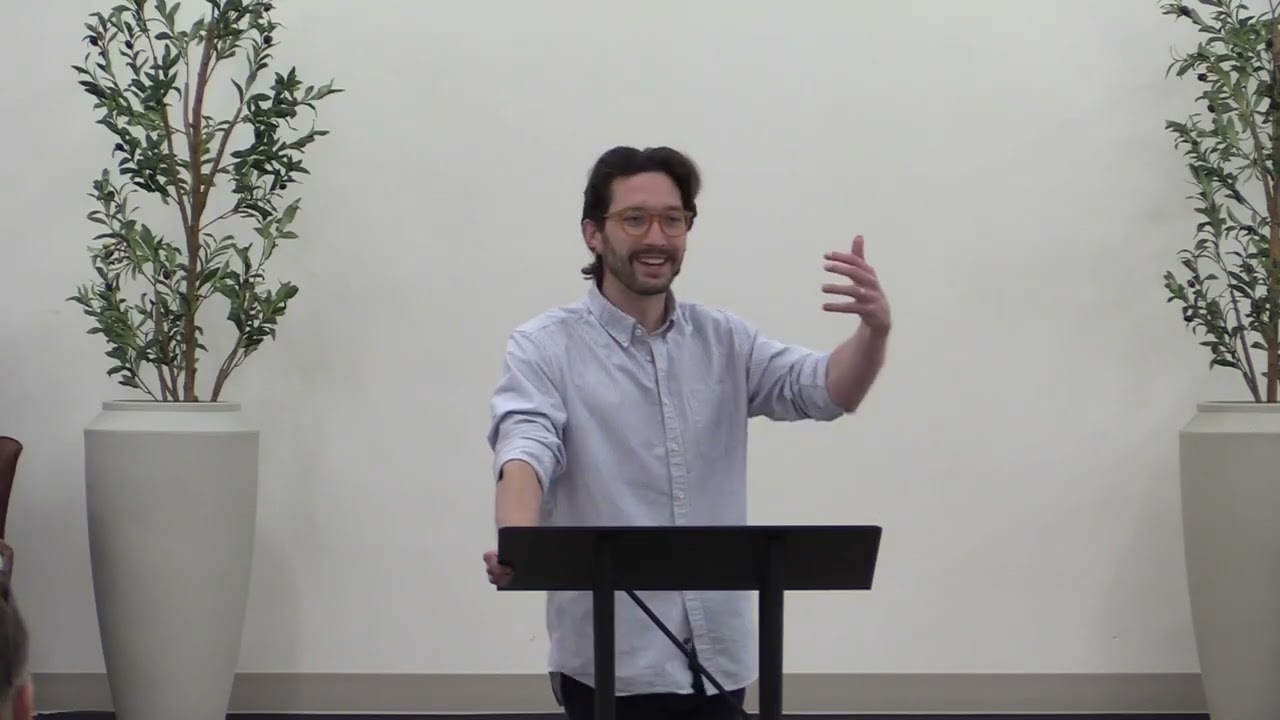
A lesson on the life and ministry of Robert Murray M’Cheyne, taught by Zack DiPrima at Trinity Church Kennesaw’s Men’s Breakfast on 2/28/26.
This message explores the life and spiritual legacy of Robert Murray McShane, the 19th-century Scottish pastor whose short life left a profound impact on the church. Drawing from McShane’s biography written by Andrew Bonar, Zack DiPrima highlights McShane’s deep communion with Christ, his pastoral ministry in Dundee, and the revival that occurred during his lifetime. The sermon emphasizes four lessons from McShane’s life: the sweetness of fellowship with God, the painful pursuit of holiness, the way communion with Christ prepares believers for service, and how extraordinary spiritual fruit grows from ordinary means of grace such as prayer, Scripture, and worship. Ultimately, McShane’s example calls Christians to cultivate a close walk with Christ and to live with urgency in light of eternity.
There came a point in the life of Jesus Christ when he compared the ministry of John the Baptist to his own. He says in John five, verse 35, John the Baptist was a burning and shining lamp, and you were willing to rejoice for a while in his light. Indeed, John was a burning and shining lamp which shone on Christ the greater light of the world.
John was a distinguished servant of God, who, until his dying day tirelessly sought to increase Christ’s fame. Jesus says he was a burning and shining light, a burning and shining lamp. Throughout the history of the church, that phrase burning and shining light has been ascribed to generational figures who spent their short lives for the glory of God. You might think of men like Charles Spurgeon, who died prematurely, David Brainerd, Henry Martin, or even Jim Elliott in the 20th century.
From a human perspective, each of these saints died prematurely. Yet we know that the God who knows the end from the beginning raises up such servants for as long as his perfect appointment permits. Brothers, there is a current that runs through each of these bright and shining lights. And the current is this: it is an acute awareness of time and a sense of the urgency of eternity—an acute awareness of time and the urgency of life.
So, for example, on his 30th birthday Henry Martin, who was a missionary to India and Iran, wrote in his journal, after years of missionary service and translating the New Testament into two different languages, he says—this is a 30-year-old man—he says, “This day I finished the 30th year of my unprofitable life. The age at which David Brainerd finished his course. I am now at the age at which the Savior of men began his ministry, and at which John the Baptist called a nation to repentance. Hitherto I have made my youth and insignificance an excuse for sloth and imbecility. Now let me have a character and act boldly for God.”
They just don’t make them like they used to. Where are the Henry Martins?
Well, brothers, Henry Martin was one of the main influences of the man to whom we now give our attention this morning, and that is Robert Murray M’Cheyne. Robert Murray M’Cheyne. His dates are 1813 to 1843. That means he lived and breathed for only 29 years. From his conversion in the early 1830s to his death in 1843, M’Cheyne led hundreds to faith. He conducted a robust pastoral ministry and left a written legacy that has touched the lives of countless Christians.
By the way, that written legacy is best preserved in a book put out by Banner of Truth called The Memoirs and Remains of Robert Murray M’Cheyne. This book is written by Andrew Bonar, who was a close friend of M’Cheyne’s. It’s probably about 500 or 600 pages. However, most of that is his sermons and his letters and his journal entries. In terms of biographical content, there’s just like 180 or 200 pages in here—very accessible.
One of the goals I have for this address this morning is that many of you men would read The Memoirs and Remains of Robert Murray M’Cheyne.
Now, my address is on his life, but it’s also about more than his life. It’s about his walk with God. M’Cheyne is remembered as one who, as Bonar says, “walked calmly in almost unbroken fellowship with the Father and the Son.”
So, brothers, my goal in this discussion is not that you mimic M’Cheyne’s ministry. Most of you are not pastors, but you are all Christian men. I want you to seek something of the same closeness to Christ that he cultivated throughout his life.
M’Cheyne once wrote to a friend, “It is not great talent God blesses so much as great likeness to Jesus.”
So, brothers, though not one of us shares the same gifts, the same intellect, or the same capacity as M’Cheyne, we all share the same access to God through Jesus Christ our Lord.
So in light of that, this is a talk on how to cultivate a close walk with Christ—how to cultivate friendship with God.
We want to consider his life. I think I have a timeline of his life in the handout before you.
Robert Murray M’Cheyne was born on May 21st, 1813, the youngest child to Adam M’Cheyne, who was the son of a prosperous lawyer. So Robert had a privileged upbringing in the lowlands of Scotland.
Raise your hand if you’ve been to Scotland. I’m just curious. I’ve never been. Would love to go and intend to go.
But to appreciate M’Cheyne’s life, you do need to—it is helpful to understand just a little bit about Scotland and her religious history. I’m just going to say a couple of things about Scotland.
Scotland has exerted a profound impact upon the world, and it is shocking considering how small Scotland is. Scotland as a country has a population smaller than the city of Atlanta. It’s a very small nation. In the time of M’Cheyne, it was probably only around two million people.
This Scotland had, at the time and on to this day, a state-sponsored church. So a national church that was founded by John Knox in 1560. John Knox—he was a close correspondent of John Calvin if you studied the Protestant Reformation. This would be the church of Robert Bruce—not from the movie Braveheart—the Puritan Robert Bruce, Samuel Rutherford, and Thomas Boston.
Now in the early decades of the Church of Scotland, the state required church attendance. So just imagine if you lived in America and it was required that you attend church. That’s how it was in much of the Reformation context of which Robert M’Cheyne was heir.
In distinction from England, free church denominations—think like Baptists, Presbyterians, Quakers—they didn’t gain much traction in Scotland as opposed to England and America. And there’s a lot of historical reasons for that.
The story of much of the 18th century—the 1700s—revolved around the problem of state magistrates and wealthy patrons appointing ministers independent of congregations and presbyteries. So it was often the case you didn’t choose your pastor. It was often somebody greasing the palm of some official, and that man gets put into that office.
This would lead eventually to the Disruption of 1843, which is the same year of M’Cheyne’s death, which led to the formation of the Free Church of Scotland comprised of evangelical Presbyterians.
I say all this to just make this simple point. M’Cheyne came of age in a time where to be Scottish meant to belong to Scotland’s church. You’re born a Scotsman. That means you’re technically a member of a church. You’ve been Christian. You’ve been baptized.
And in such a situation, regardless of what your views on paedobaptism or establishmentarianism of religion—regardless what your opinions on that—that does in many ways mainline a sort of nominalism in a culture.
In Robert’s case, this meant his family was Christian in name only, having no meaningful commitment to the Word of God. So that’s the context of where and how Robert grew up.
But I want to talk about his early life and conversion.
Robert’s wealthy upbringing afforded him the privilege of a fine education. He evidenced prodigious gifts by four years old, knowing all the characters of the Greek alphabet. His thirst for learning would serve him the rest of his life.
Years after entering the ministry, he exhorted young men. So boys, I want you to listen to this. M’Cheyne said, “Remember now you are forming the character of your future ministry in great measure, if God spare you. If you acquire slovenly or sleepy habits of study now, you will never get the better of it. Do everything in its own time. Do everything in earnest. If it is worth doing, then do it with all your might.”
My mom said that to me many times growing up. If it’s worth doing, do it with all your might.
Though his early life was marked by serious study, he moved frivolously through his high school and college years, filling his days with worldly amusements such as parties, card playing, and dancing. Brazen and careless, M’Cheyne ambled through life until the Lord gripped him by the sudden death of his elder brother David.
David, M’Cheyne’s elder brother, had himself recently been converted and would make Robert the subject of his fervent prayers.
Reflecting on David’s untimely death, Robert described his bereavement in 1831. He said it was “the first overwhelming blow to my worldliness.” It was the first thing that shook him from the stupor of sin and began to lead him to Jesus Christ.
He would go on to mark his brother’s death every year thereafter. In the last year of his life he wrote, “To this day eleven years ago I lost my loved and loving brother and began to seek a brother who cannot die.”
From the moment of his conversion, Robert earnestly followed Jesus Christ.
This demonstrated itself in a stark break from sin. He no longer gave himself to the worldly activities of his former life. Instead, he diligently studied the Scriptures and the biographies of past ministers such as Jonathan Edwards, David Brainerd, and Henry Martin.
From Edwards he learned the value of making holy resolutions with eternity in view. Many of you may have heard of Jonathan Edwards’ resolutions—great reading.
M’Cheyne himself had several resolutions. For example he said:
“Resolved, never to lose one moment of time, but to improve it in the most profitable way I possibly can.”
“Resolved, that I will live so as I shall wish I had done when I had come to die.”
“I resolve to live with all my might while I do live.”
Reflecting upon the life of the missionary Henry Martin, he wrote in his journal, “I am reading Henry Martin’s memoirs. Would I could imitate him—giving up father, mother, country, house, health, life—all for Christ. And yet what hinders? Lord purify me and give me strength to dedicate myself, my all, to thee.”
On his graduation from university he declared, “College finished on Friday last. My last appearance there. Life itself is vanishing fast. Make haste for eternity.”
M’Cheyne soon began ministry after his university years. On July 1st, 1835, he was licensed to preach by the Presbytery of Annan, where he served as the assistant minister of Larbert.
In November of 1836, he was appointed as the pastor of Saint Peter’s, Dundee, a neglected district of 4000.
Anthony, have you been to Saint Peter’s Dundee? Much to speak of? Does it look nice? As beautiful as a faithful church today? Also another local church. Awesome. That’s rare in post-modern Britain.
In the early nineteenth century it was a district of 4000. But by the early nineteenth century Dundee was a city of booming industrial advance. Over the course of the first decades of the 1800s, the Industrial Revolution led to meteoric growth, relatively speaking for Scotland. So it grew to around 57,000 citizens, which was more than an order of magnitude growth during this period, which brought a lot of challenges to the parish.
The Industrial Revolution had exacerbated the poverty of the community, with many men, women, and children having to work 12 to 16 hours per day in factories.
This cultural shift also produced a moral decline. During Robert’s days in Dundee there were 11 shops to buy bread and 108 pubs. So you see where their priorities were. It is estimated the average worker spent 25% of his income on alcohol.
Upon his arrival, Robert described Dundee as a city given to idolatry and hardness of heart. His biographer Andrew Bonar went further to describe its depravity. He said the surrounding mass of impenetrable heathenism cast its influence even on those few who were living Christians.
So what did M’Cheyne do when he arrived in Dundee?
M’Cheyne gave himself to a robust pastoral ministry. Namely, he met everyone. He sought to greet every resident in his community, visiting them door to door.
As a pupil of Thomas Chalmers, Robert viewed himself indebted to all the people in the geographical range of his parish. That’s basically how parish ministries work in the Church of Scotland then, and the Church of England and Anglican circles even to this day.
He sometimes visited as many as 20 to 30 families in one day. So in case you’re thinking, wait Pastor Zach, you really need to be going door to door. I mean these aren’t really long meetings. This is like ten minute meetings with the family. Go over a couple of catechism questions, then on to the next neighbor’s house. But still diligent and caring of people nonetheless.
The result was a parish gradually warmed to the zeal of an affectionate pastor.
By the end of his ministry, the congregation of Saint Peter’s was overflowing with a capacity of over 1100 men and women.
Okay. I want to consider next what was a strange hiatus in M’Cheyne’s life.
M’Cheyne’s short ministry was punctuated by a hiatus which began in 1838. At this point he is like 26 or 27, very young. He experienced increasing heart palpitations which led him to retire to Edinburgh for recovery.
During this time he wrote letters to his congregation, and these letters provide a window into M’Cheyne’s heart and pastoral affection. Many of those letters are included in that book here on the front row.
After a few short months Robert was invited to go on an expedition in 1839 to Palestine.
Fascinating.
His desire to travel to the Near East stemmed from his premillennial convictions, including the belief that God had ordained a mass conversion of Jews. Now when I say premillennial by early nineteenth century standards, do not think modern American dispensationalism. It is something different from that, but it is premillennial in its eschatology.
But his view that the Lord would be pleased to save a mass amount of Jews before the end of time—that is actually a common view held among many different Christians whether they are amillennial, postmillennial, or like M’Cheyne premillennial.
In the summer of 1839 M’Cheyne began his journey through Asia Minor, then Turkey. Despite the benefits of his travels, his health had not significantly improved.
Experiencing continued bouts of severe illness, Robert thought he would die soon there in a foreign land.
However, the Lord still had plans for this young minister.
Okay, we are through 1838 to 1839. I want to consider this sort of final chapter of his life: revival and final years.
As M’Cheyne slowly recovered in modern-day Turkey, revival broke out in Dundee in the summer of 1839.
He is over in Eastern Europe in the Middle East, and there is revival happening in his hometown, in his home church, under the ministry of another person.
Under the ministry of William Chalmers Burns, then 24 years old, God visited the region in ways he had in previous evangelical revivals.
An extended quote from Bonar sheds light on the spiritual climate of the revival. He shares about a gathering after a meeting of the church.
Bonar says:
“About a hundred remained after this service, and at the conclusion of a solemn address to these anxious souls suddenly the power of God seemed to descend and all were bathed in tears. At a similar meeting next evening in the church there was much melting of heart and intense desire after the beloved of the Father.
On adjourning to the vestry the arm of the Lord was revealed. No sooner was the vestry door open to admit those who might feel anxious to converse than a vast number pressed in with awful eagerness. It was like a pent up flood breaking forth. Tears were streaming from the eyes of many and some fell on the ground groaning and weeping and crying for mercy.
Onward from that evening meetings were held every day for many weeks, and the extraordinary nature of the work justified and called for extraordinary services. The whole town was moved.”
Amazing things happening in Dundee. Revival happening in Dundee. Preaching and the ministry of the Holy Spirit shaking Dundee.
But I think what is the most remarkable part of this whole narrative is the way M’Cheyne responds.
Namely, the joy he experienced on behalf of his congregation.
Bonar writes how he delighted in the state of his parish. Though he took no part in the activities, he had no envy at another instrument having been so honored in the place where he had himself labored with many tears and temptations.
In true Christian magnanimity he rejoiced that the work of the Lord was done by whatever hand.
Upon his return in November of 1839, M’Cheyne commented on the worship of his people. He said the people felt that they were praising a present God.
Now despite the exhilaration of the revival, the scene in Dundee was not without challenges. Without breaking bruised reeds, M’Cheyne retained caution in receiving new converts. It was his custom never to accept mere professions of faith as final signs of conversion.
He warned his people, “Without holy fruit all evidences are vain. Dear friends, you have had awakenings, enlightening experiences, a full heart in prayer, and many other signs. But if you lack holiness you will never see the Lord.”
M’Cheyne was well aware of the reality of remaining sin. Thus he endeavored to emphasize the desire for and pursuit of holiness in distinction from total perfection. He said the desire for holiness was the truest mark of being born again. It was a mark that God had made us meet for the inheritance of the saints in the light.
The remaining three years of M’Cheyne’s life witnessed the power of revival calmed by the steady hand of a gentle shepherd.
In the spring of 1843 Robert again fell ill, this time not to return to ministry. His last message at Saint Peter’s came from Romans nine, where he spoke with peculiar strength on the sovereignty of God.
The following Tuesday he spoke to a group of children on Christ as the Good Shepherd, which I find rather notable—the last two things he instructed from God’s Word.
His final words were expressions of confidence in the sovereign grace of God as well as the ministry of the great Shepherd who had held him to the last.
Robert M’Cheyne departed into the eternal realm of glory on March 25th, 1843.
That is the life of M’Cheyne.
In the time remaining I just want to consider four lessons from his life, particularly his friendship with God.
And when I speak of friendship with God, I refer to what we often call fellowship or communion with God. I refer to a vibrant living relationship with God the Father, empowered by the Holy Spirit and flowing from an abiding faith in the Son.
In his life and death M’Cheyne demonstrated remarkable gifts that we simply cannot replicate. None of us should be trying to be M’Cheyne.
But he also embodied a closeness with Christ, a quality of fellowship that can and should be pursued by all of God’s people.
Pursue something of the relationship that M’Cheyne pursued with Christ.
Four things about M’Cheyne’s friendship with God.
First, M’Cheyne’s friendship with God was sweet and exhilarating.
Upon conversion M’Cheyne sought to cultivate a secret history with God. He never sought to turn his piety into performance.
It’s always odd reading about dead men because you somehow recover their journals. Most men like that do not intend their journals to be read.
He sought to cultivate a secret history with God.
He wrote in 1838, “Much peace and rest tonight. Much broken under a sense of my exceeding wickedness which none can see but thine. Much persuasion of the sufficiency of Christ and of the constancy of his love. Oh how sweet to work all day for God and then to lie down at night under his smiles.”
M’Cheyne lived off the thrill of a voracious hunger for God.
Day in and day out he sought the joy and fellowship of the Lord.
He writes, “To gain an entire likeness to Christ I ought to get a high esteem of the happiness of it. I am persuaded that God’s happiness is inseparably linked with his holiness. Holiness and happiness are like light and heat.”
God never tasted one of the pleasures of sin.
M’Cheyne is saying, I should be a holy man because I want to be a happy man. And I want to be a happy man, so I should be a holy man.
Who is the happiest being that exists? God. He is the blessed God. He is the happy God.
Holiness and happiness are inseparably linked.
Elsewhere he writes, “I am persuaded that I shall attain the highest amount of present happiness, I shall do most for God’s glory and the good of man, and I shall have the fullest reward in eternity by maintaining a conscience always washed in Christ’s blood, by being filled with the Holy Spirit at all times, and by attaining the entire likeness of Christ in mind, will, and heart that is possible for a redeemed sinner to attain in this world.”
M’Cheyne was fed by the pleasure of adoption.
Bonar writes that he lived in blessed consciousness that he was a child of God—humble and meek just because he was fully assured that Jehovah was his God and Father.
Many often felt that in prayer the name “Holy Father” was breathed with peculiar tenderness and solemnity from his lips.
So brothers, M’Cheyne’s friendship with God was exhilarating.
But secondly, M’Cheyne’s friendship with God was excruciating.
For M’Cheyne, along with all who seek holiness, closeness with Christ came at a cost.
What I mean to emphasize here is his priority of communion brought him face to face with his own wickedness.
M’Cheyne echoed the cry of David who said, “Search me O God and know my heart. Try me and know my thoughts and see if there be any grievous way in me and lead me in the way everlasting.”
The scathing exposure of ourselves to God’s holiness is excruciating because it reveals remaining corruption.
One of the themes that you see again and again in M’Cheyne’s life is his diligence to maintain a clean conscience before God.
It often came at a great cost—confession of sin, putting off the pursuit of pleasures, worldly amusements, and constantly seeking greater likeness to Jesus.
It is not easy, the path of holiness.
Robert’s path to eternal life was not paved with gold. It was worn through the scathing appraisal of his own remaining sin.
Bonar writes that his soul was prepared for the awful work of ministry by affliction in his person, by inward trials and sore temptations, by experience of the depth of corruption in his own heart, and by the discoveries of the Savior’s fullness of grace.
So I say M’Cheyne’s progress in holiness was met with an increased awareness of his own faults.
He said, “I have been too anxious to do great things. The lust of praise has ever been my besetting sin.”
But his fight with sin did not finish with the mere awareness of it. Rather he moved to acknowledge that sin to God in regular confession.
M’Cheyne writes, “To maintain a conscience void of offense I am persuaded that I ought to confess my sins more. I think I ought to confess sin the moment I see it. Whether I am in company or in study or even preaching, the soul ought to cast a glance of abhorrence at the sin.”
The most important thing in your life is maintaining a clear conscience before God.
M’Cheyne mastered the art of keeping short accounts with God.
The more he comprehended the character of God, the deeper he comprehended his own sinfulness, which plunged him deeper into the marvelous grace of God.
So I say his friendship with God was excruciating.
Thirdly, M’Cheyne’s friendship with God prepared him for service.
M’Cheyne’s legacy was a living rebuttal to the notion that Christians can be so heavenly minded that they are of no earthly good.
Rather M’Cheyne’s close walk with God formed the bedrock of his intense activity in ministry.
Deep communion with the Son and study of God’s Word were not in conflict with great service.
Bonar attests that the commencement of all his labors invariably consisted in the preparation of his own soul.
The forerunner of each day’s visitations was a calm season of private devotion during morning hours.
Through meditation day and night the Word of God had become the foundation of M’Cheyne’s life.
The most productive people in the world are those who give themselves diligently to spiritual graces.
Fourthly and lastly, M’Cheyne’s friendship with God made extraordinary use of ordinary means.
One of the most striking things about M’Cheyne’s walk with God is that it did not emerge from anything spectacular.
If you read his biography or journal you will find a man who committed himself to the most ordinary habits of grace.
Bible reading. Prayer. Corporate worship.
M’Cheyne prioritized all of these.
He writes in 1834 speaking of his own experience on the Lord’s Day, “I rose early to seek God and I found him whom my soul loves. Who would not rise early to meet such company?”
The real secret of his soul’s prosperity lay in the daily enlargement of his heart in fellowship with his God.
If I could distill M’Cheyne’s piety into one idea, it would be that he lived ceaselessly in the presence of a living Christ.
Jesus was his friend.
Jesus was no abstraction to M’Cheyne.
He personally applied the presence of Christ every day of his life.
He wrote, “If I could hear Christ praying for me in the next room I would not fear a million enemies. Yet distance makes no difference. He is praying for me.”
How can we fear when we have such a Christ as our friend?
I leave us with the words of M’Cheyne to a friend, a plea for fellowship with the Lord.
“Oh for closer communion with God, till soul and body, head, face, and heart shine with divine brilliancy. But oh for holy ignorance of our shining. Pray for this, for you need it as well as I.”
Let’s pray.
Father in heaven, that is our prayer. We want closer communion with you.
Lord, I pray every man and boy in this room would not only know you as their Savior but know you, Father, as their heavenly Father.
Lord, help us pursue great likeness to Jesus Christ.
Help us learn from this saint Robert M’Cheyne.
Lord, we do not worship him as a hero. We know he had feet of clay. But so much as he modeled fellowship with your beloved Son, may we follow him.
Help us now Lord. Many of us are husbands. Many of us are fathers.
In all the callings you have brought us to, may we show something of great likeness to Jesus Christ and a fervor for you.
Lord prepare our hearts for the Lord’s Day tomorrow.
We pray in Jesus’ name.