In this sermon on John 8:30–36, Zack DiPrima contrasts the illusion of human freedom with the reality of spiritual bondage and the true freedom found in Jesus Christ. While many assume they are free, Jesus teaches that everyone who practices sin is enslaved to it and remains under its dominion. True freedom is not autonomy or self-expression, but deliverance from sin through the Son, who alone can set sinners free. This freedom is both positional and transformative—freeing believers from condemnation while also producing a new love for God’s Word, a hatred of sin, and a growing desire to obey Christ. The sermon calls hearers to recognize their bondage, come to Christ in faith, and abide in His Word as the pathway to genuine and lasting freedom.
This sermon is also available on Spotify and Apple Podcasts.
If you have your Bibles with you, please turn in them to John chapter eight.
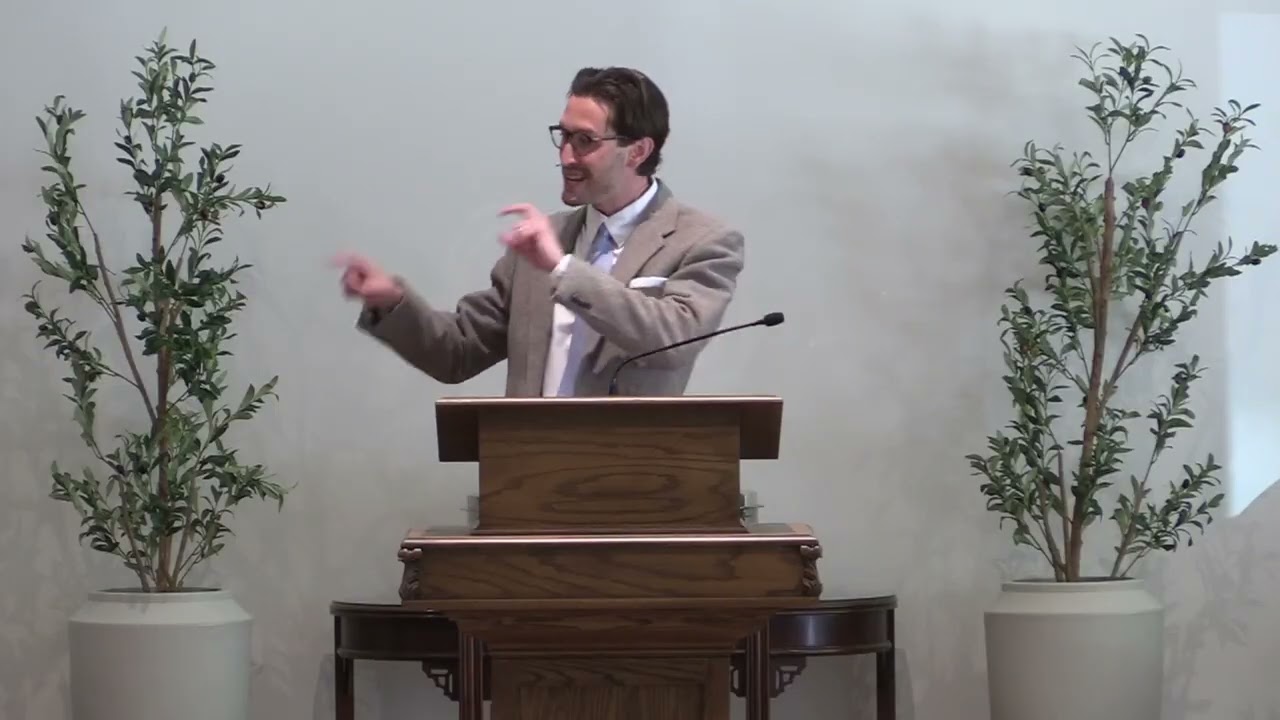
As you turn there, I should say we’re in a season of church life where every couple of weeks or so there’s some sort of building improvement or some modification that’s minor, sometimes major, that is usually very positive. We’ve made two recent changes that are to your advantage, but not to mine. The first advantage that you have is there’s this pulpit mic here. It’s built into the pulpit, but it casts a shadow on my text. And also I’m Italian. I use my hands. So I’m very worried about how this is going to work out. You know, some of you make Italian motions at me. My culture is not your costume. Only I’m allowed to do that because I’m Italian, so I’m a little worried about how that’s going to go.
Pastor Kalep said, I do have permission to… I can turn it down and you can still hear me. The mix. Okay, we’ll see how this goes. The second thing is the lights are different. The Lord has provided new lights for this facility. Some of them donated. It’s been wonderful to have these lights, again, not to my advantage. The last lights were brighter, and you weren’t going to fall asleep in this room last week with the lights the way they were before. As somebody has affectionately said, “hey, I love Trinity Church’s worship, but that room looks like a mental ward because of the lights.” Now we have, I guess, better lighting. Let me just encourage you please stay awake as I preach to you. Now friends, with this out of our mind, I want to read verses 30 through 38 of John chapter eight.
I’m going to touch on verses 37 and 38 today, but we’re going to cover those verses more in detail next time in our series through John. But listen now as I read John eight verses 30 through 38, Jesus speaking to the Jews.
As he was saying these things, many believed in him. So Jesus said to the Jews who had believed him, “If you abide in my word, you are truly my disciples, and you will know the truth, and the truth will set you free.” They answered him, “We are offspring of Abraham and have never been enslaved to anyone. How is it that you say you will become free?”
Jesus answered them, “Truly, truly, I say to you, everyone who practices sin is a slave to sin. The slave does not remain in the house forever. The son remains forever. So if the Son sets you free, you will be free indeed. I know that you are offspring of Abraham. Yet you seek to kill me because my words find no place in you. I speak of what I have seen with my Father, and you do what you have heard from your father.”
Let’s go to the Lord once more in prayer. Let’s pray.
Father, we ask now simply what we know not, you would teach us; what we ask not, you would grant us; and what we are not, you would make us, by the power of Your Holy Spirit. Shape us. Change us, Lord. Set us free by the truth. Cause us, those of us who are in Christ, with greater fullness to abide in His Word. We want to be true. We want to be real. We want to be genuine disciples of Jesus. Father, equip us now and for the many in this room that know you savingly, would you acquaint them with the mercy that is found in Christ? Bless us now we pray in Jesus’ name. Amen.
I don’t know if you’re familiar with the famous British patriotic anthem Rule Britannia, but it’s awesome. I love the song Rule Britannia! I won’t sing it for you now, but you’ve probably heard it if you’ve seen movies. The chorus goes, “Rule, Britannia! Britannia, rule the waves! Britons never will be slaves.” It’s a simple notion. It was written in 1740. The idea is, Britons, we don’t get walked over. We’re not anybody’s slave. We’re not anybody’s whipping boy. No, actually we rule. We are free.
The song Rule Britannia expresses an innate yearning for freedom. You may know that the battle cry of the French Revolution and a famous motto to this day is “Liberty, equality, fraternity.” Italy and her national anthem boast a willingness to die for freedom. And I’m reliably informed that even Germany’s national anthem—and you can confirm this or not—but the, I think the opening three words of the national anthem are “unity, justice and freedom.”
Everybody loves freedom. Everybody wants to be free. Everybody thinks they’re free. Everybody likes to identify as free, not as subject, not as a slave. And this isn’t just a Western idea. China’s national anthem, for example, opens, “Arise, you who refuse to be slaves.” Even Iran, the country Americans at war with right now, they say this: “The imam’s message of freedom and independence are written upon the soul.”
Freedom. Independence written upon the soul, say the people of Iran. The point is simple: everybody loves freedom. Everybody hates slavery. Perhaps it’s more precise to say everyone thinks they love freedom and everyone thinks they hate slavery. Maybe to say it even more precisely, people prefer to think of themselves as free, when in reality most people, regardless of race, ethnicity, class, or nation of origin, are in fact enslaved.
So the Bible teaches this is why people need the gospel. Friends, the message of the gospel is freedom and salvation from the slavery of sin. That’s what Jesus provides: freedom from the slavery and the shackles of sin. Jesus Christ is the truth teller and his message sets us free. Jesus frees slaves. He liberates captives. He breaks chains. He cancels debts. He ransoms the ransacked. He buys people out of bondage. He removes heavy yokes. He transfers from one dominion of bondage to a dominion of liberty, freedom.
Friends, the living Christ is that Son who sets people free. But alas, unless you understand the bondage, you’ll never understand the freedom unless you understand what it means for your soul to be enslaved by sin and Satan. You can never experience the freedom that Christ provides. So many people will go to hell thinking they’re free, because they never truly comprehended the bondage that they were in. I know that because that’s what our text says. The people that Jesus speaks to, so many of them don’t receive him because they say “We’re free. We’ve never been enslaved to anyone.” They don’t understand bondage, and thus they don’t understand the gospel, because they don’t understand the true freedom that Jesus provides.
I heard a pastor say recently—I found this extremely helpful in ministry—there are really only two tasks. The first task is convincing people who are under the dominion of sin that they are in fact under the dominion of sin. Friends, that’s what evangelism is. You know what it means to evangelize. It’s to teach the gospel with the aim to persuade people who don’t know Jesus. And part of that message means understanding that you are a sinner, convincing people who they’re subject to.
The other task is also extremely important, and that’s convincing people who are under the dominion of Christ that they are truly under the dominion of Christ. They’re free in Christ, and they’re bound to Christ. And that changes everything about the Christian life, everything about Christian experience.
I have three points this morning from our text. The first point is the offer of freedom. Secondly, the terror of bondage. Third, the nature of freedom. We got the author of freedom. Point number one, point number two, the terror of bondage. And point number three, the nature of freedom.
Point One: The Offer of Freedom
Look at verse 30. You need to look at verse 30. Some of you might have a subtitle over in your ESV Bibles over verse 31. That can sometimes give a sense that these texts aren’t flowing together. I really think we need to understand the context of most of our text is coming out of verse 30, and even prior to that.
Look at verse 30. It says, “As he was saying these things, many believed in him.” So Jesus said to the Jews who had believed in him, “If you abide in my word, you are truly my disciples, and you will know the truth, and the truth will set you free.”
We need to understand what Jesus offers in this text, but before that, we need to understand who is he speaking to? Who is he speaking to? Because what he says in verse 31 is to the people in verse 30. Verse 30 says, many believed in him, and they believed as he was saying these things. That’s a reference to the preceding verses where he told his hearers, “Unless you believe that I am he, you’re going to die in your sins.” And people respond. They’re believing in him.
And it’s very important that we see what they’re believing on him for. Because John also often tells us why certain people believe throughout his gospel. Sometimes it’s because of the signs and because of the miracles. Sometimes it’s because of some sort of response of excitement. Here, he says, because of the words that were coming out of his mouth, those are germinating and producing some species of faith, some type of belief in verse 30.
Big question if you’ve been reading the Gospel of John and you’ve been in this series through John: Is it real? Is the faith of these people in verse 30 real, or is it counterfeit? Or maybe it’s unformed and just not yet approaching real, genuine faith. What’s the answer to that question? Rather than I believe that this is mostly genuine faith. And I believe that for a few reasons.
I think the faith is real instead of false, because John has ways of signaling when certain faith is false. And also we can see that in the way Jesus responds to certain counterfeit faith throughout the Gospel of John. Let me just say this. You don’t need to agree with me on this, that the people in verse 30 were primarily believers or not. I’m going to build this case. You can take it or leave. It doesn’t take away from the main idea of the sermon or the main idea of the passage, but it’s important nonetheless.
You can look back in your Bibles or you can listen. As I read John 2, verse 23. Notice John’s description of the people who have faith, and Jesus responds to these people. It says, “Now when he was in Jerusalem at the Passover feast, many believed in his name when they saw the signs that he was doing.” Now, it’s not always bad to respond to signs, but signs could be misleading, and the result of signs doesn’t always produce genuine faith. And John wants us to know these people received Jesus. They are said to believe in Jesus on account of the signs.
Well, how does Jesus respond? In John 2 verse 24, it says, “But Jesus on his part did not entrust himself to them, because he knew all people and needed no one to bear witness about man, for he himself knew what was in man.” Jesus could peer into those people’s hearts and know this isn’t real, and it does not, in fact, entrust himself to them.
You can look at John 4, verse 48. Jesus exposes the formless faith of the Galilean official. Jesus said to him, “Unless you see signs and wonders, you will not believe.” He’s interrogating the formless, and at that point not yet genuine faith of that man coming to get his son healed.
John 6 verse 14. We saw when many sermons in John, in John chapter six, the false faith of the fed 5,000. It says in John 6 verse 14, “When the people saw the sign that he had done, they said, ‘This indeed is the prophet who has come into the world.’ He’s given us bread, he’s provided us sustenance. This is the prophet.” It seems like a great and grand and positive response. Do you know how Jesus responds? He withdraws himself from them. And as we see by the end of John 6, revealing that this was a fickle crowd, they did not have sincere faith in Jesus.
Now I find a massive distinction and difference between how Jesus responds to our people in John 8. At least the people in verse 30 than he does in those previous texts. The Lord’s response in our text appears to be more direct and sincere than elsewhere. And this leads me to conclude that the people in verse 30 are in fact sincere professors. So maybe not yet passed from death to life, but they’re sincerely coming to Jesus. Some of them maybe have passed from death to life. And there in this larger crowd, that crowd that is largely unbelieving.
Now, you may notice there’s an obvious problem that arises in verse 33. It says, “They answered him.” They answered him, “We are offspring of Abraham and have never been enslaved to anyone. How is it that you say you will become free?” Jesus then begins to speak, antagonistic to the crowd. He says, then in verse 37 to 38, “I know that you are offspring of Abraham. Yet you seek to kill me, because my words find no place in you. I speak of what I have seen with my Father, and you do what you have heard from your father.”
So, brethren, as Bible people, especially in light of what I’ve just argued, we need to ask the question, who is Jesus primarily addressing in verse 33 through the rest of the chapter? Who is the “they” referred to in verse 33?
Now, here’s the thing. I’m always going to be honest with you. The majority of commentators argue that the people in verse 30 were mere professors who immediately defect from their faith and reject Christ. So the same exact people that we see in verse 30. Now, that’s the majority of commentators, but me and John Calvin say otherwise. And when you have John Calvin on your side, you have the strength of 10,000 armies. And Calvin gets a lot of things wrong. But I think he’s right here. And that is to say that the people in verse 33.
The idea that the “they” would refer to the same exact people in verse 30 does not make sense of how John deals with false faith throughout his gospel. And it also doesn’t plausibly explain, at least to me, how the people who believe in Jesus in verse 30 are said to seek to kill him in the very next verses. You follow me like that to me, narratively doesn’t make a lot of sense. Usually when we see that sort of shift in sentiment, it’s over a long discourse. This it’s in one exchange. And that doesn’t, to me quite add up to the positive sort of response whoever in verse 30 is showing.
Therefore, my conclusion is that the people who believe in verse 30 are a subset of the John, a crowd comprised of true and true believers and temporary professors, while the people in verse 33, referred to as “they” are the expanded crowd of the Jews that have been pressing Jesus throughout the whole festival.
Okay, we’re done with that diatribe of who Jesus is talking to. To me, it’s actually not fundamentally important that you agree with that interpretation or not. What matters is what you understand Jesus to be saying in verses 31 and 32.
Here’s the question: What does Jesus offer? What does he warn? What does he invite people to participate in? How does he define discipleship? How does he define the Christian life?
Jesus says to these disciples and would-be disciples in verse 31, “If you abide in my word, you are truly my disciples, and you will know the truth, and the truth will set you free.” He goes on to say that the slave does not dwell in the house. The slave dwells in the slave quarters, but the son, the free one, dwells in the house. Verse 36. Famous verse: “If the Son sets you free, you will be free indeed.”
Jesus’ point here is so simple. Jesus is offering salvation to himself. He’s offering freedom and liberty through faith in him. Jesus is the only one that makes people free and keeps people free. Following Christ is the only way to experience deliverance from slavery. Jesus is said to be the way, the truth, and the life. No one comes to the Father but through him. For whatever bondage and slavery means in this text, and we’re about to look at what slavery and bondage are. But whatever they are, Jesus is the exclusive means of freedom. There’s no other way you could be liberated from the type of shackles the rest of the verses are going to describe, but through Jesus Christ, the way, the truth and the life. Access to the Father through him, repentance from your sins and believing on the Lord Jesus Christ.
But now we need to ask the crucial question: What is bondage and what is freedom? As I said a moment ago, if you’re outside of Christ, you will never understand Christianity unless you comprehend the bondage you’re in. And if you’re in Christ, this is why what Jesus is going to teach here is just so fundamental to Christian experience. If you’re in Christ, you’re likely never to progress in the Christian life, grow in the Christian life unless you understand the nature of the freedom that he provides.
Point Two: The Terror of Bondage
Look at verse 33. They answered him, “We are offspring of Abraham and have never been enslaved to anyone. How is it that you say you will become free?” Jesus answered them, “Truly, truly, I say to you, everyone who practices sin is a slave to sin. The slave does not remain in the house forever. The son remains forever. So if the Son sets you free, you will be free indeed. I know that you are offspring of Abraham. Yet you seek to kill me because my words find no place in you. I speak of what I have seen with my Father, and you do what you have heard from your father.”
Jesus speaks of spiritual slavery in this text, and he issues three indictments against his Jewish audience. I want to just give you a simple definition of spiritual slavery. Some of y’all are helped by definitions. Here’s a definition for spiritual slavery: Spiritual slavery is a status in which we are under the dominion of Satan, desire and practice sin. Spiritual slavery is a status in which we, under the dominion of Satan, desire and practice sin. If I were to add a sentence to that definition, I would say from such a status, sinners recoil from Christ and His Word and find no pleasure in God.
This type of slavery leads people to recoil from Christ, recoil from his teaching and His Word, and they find no delight or pleasure in God. I say Jesus issues three indictments against the Jews.
First, Jesus says the Jews are slaves because they practice sin. They are slaves because they practice sin. Look at verse 34. Jesus answered them, “Truly, truly, I say to you, everyone who practices sin is a slave to sin,” and it’s here and many other places in the New Testament where we realize it’s not just the Jews who were slaves to sin. Anyone who practices sin is a slave to sin.
The Jews were not uniquely enslaved. No, this is all those who are born in sin, all of those who are in Adam, and we are obedient slaves. Paul says in Romans 6, “Do you not know that if you present yourself to anyone as obedient slaves, you are slaves of the one whom you obey, either of sin, which leads to death, or of obedience, which leads to righteousness?”
John commenting on John, he says in 1 John 3 verse 4, “Everyone who makes a practice of sinning also practices lawlessness.” That word “practice” is going to be very important in a moment. Sin is lawlessness. You know that he appeared in order to take away sins, and in him there is no sin. No one who abides in him keeps on sinning. No one who keeps on sinning has either seen him or known him.
And here’s brethren, what we need to understand as New Covenant believers, as Christians, followers of Christ. The Bible draws a distinction between the practice of sin and the presence of sin. There is a real difference between the self-conscious practice, obedience to sin as a master and the remaining presence of sin in people’s lives.
So if you’re hearing what I’m saying, and you have alarm bells going off and aware of your sin, think, “Oh, I must not be a Christian because I’m a sinner.” That’s so obviously what the Bible does not teach. There’s a difference between the practice of sin and the presence of sin remaining in the heart of the believer. And this is how John comments on this. In 1 John 1 he says, “If we say we have no sin, we deceive ourselves, and the truth is not in us. But if we confess our sins, he is faithful and just to forgive us our sins and to cleanse us from all unrighteousness.”
Brethren, every Christian has the remaining presence of sin in his or her life. But the Christian, as opposed to the non-Christian, the Christian has a fundamentally different relationship with that sin. An unbeliever surrenders to sin. An unbeliever doesn’t struggle with sin. An unbeliever loves it. Sin. Oh, but the Christian wages a war against his sin, especially if he struggled with assurance, something that I’ve just learned as a Christian myself. I’ve learned for years as a pastor, I can tell so much about your relationship with God, not by whether or not you sin, but by what you do when you sin. Every person I know sins. It’s not about your report card on any given week, it’s what do you do when you sin? Do you fly to Christ? Do you repent? Do you hate that sin? Do you turn away from that sin? Do you run to Jesus? That’s what the Christian does.
This was never riding on you in the first place. You’re not saved by your own merit. You’re not saved by your own performance. You’ve always been and always will be saved by the blood and righteousness of Jesus Christ. It’s always about him. But the gospel changes a person, and the gospel changes and creates a fundamentally different relationship to sin than what you had before.
So, my friend, what is your relationship with sin? If you have made a peace treaty with your sin, “This is how I am. I know Jesus says this. I know the Bible teaches this, but I don’t care. This is my sin. This is what I choose to be.” You’re almost certainly not a Christian. That’s not what a Christian says to sin. A Christian turns away from that sin and holds fast to the Lord Jesus Christ and runs to him. Let that encourage you.
When we take the Lord’s Supper in a few moments, the Lord’s Supper is for sinners, real dirty sinners. But they’re repentant, and they are those people who have applied to the Lord Jesus Christ to experience all the benefits that his cross and resurrection provide.
Some of you struggle with this with people in your life who profess to be Christians, but may not be. Maybe you’re wondering. Maybe you have a father or mother, or brother or sister or coworker that says he or she is a Christian, and you’re just not sure if they’re a Christian. Here’s two questions you can ask them, or two questions you can ask yourself about their life. What do they do when they sin? And the second question is similar. It’s like it, but it’s different. How do they respond to the Word of God?
Did you notice what Jesus says? “Whoever abides in my word.” Jesus is not extracted from his word. He cannot be. How does that person respond to the scriptures? How does that person respond to the law of God? How does that person respond to the way of holiness? Because that is the Word of Christ. If they reject the Word of Christ, they are like those goats that don’t hear his voice. Oh, but true children of God, true sheep of his fold. They respond to his word. It’s like balm to the soul, medicine for the sick and heals them and they obey it.
Romans 8:7 says, “The mind that is set on the flesh is hostile to God, for it does not submit to God’s law. Indeed it cannot.” The man outside of Christ possesses a heart and slave to sin. His hands are bound and his eyes are blind. 1 Corinthians 2 says, “The natural person does not accept the things of the Spirit of God, for they are folly to him, and he is not able to understand them because they are spiritually discerned.”
Jesus’ first indictment against the Jews is they are slaves because they practice sin.
Secondly, Jesus says the Jews are slaves because Abraham is only their physical father. Okay. Verse 37, “I know you are offspring of Abraham.” It’s one of those rare moments where you don’t want Jesus agreeing with you because what he’s about to say. “Yet you seek to kill me because my words find no place in you.” Jesus tells them, “I know that you’re Abraham’s offspring, I don’t care.” No one is made right with God through the right family ties or pedigree. Jesus says in Matthew, “God can make children of Abraham from rocks.” Doesn’t mean anything. If Abraham you descend from his lineage, it does not produce saving faith. Do you have Abraham’s faith?
Romans 9 says, “For not all who are descended from Israel belong to Israel, and not all are children of Abraham because they are his offspring.” This means that it is not the children of the flesh who are the children of God, but the children of the promise are counted as offspring.
And he says it’s even more clearly in Galatians 3: “Know then that it is those of faith who are the sons of Abraham.” So Jesus is saying, physical connection to Father Abraham is fruitless unless you have Father Abraham’s faith. You’re not Isaac the child of promise. You’re Ishmael, the child that’s in bondage. You’re a slave, because you practice sin and you hate me. You’re not a child of freedom, but a child of slavery.
And he says, even worse than that, the third indictment, Jesus says the Jews are slaves because their father is the devil. We’re going to consider this more next time. There’s a Satan is their father. The Jews ultimately bore the family resemblance of their father, Satan. This can be seen in their fruit, primarily their unbelief. He says, “I speak of what I have seen in verse 38 with my Father, and you do what you have heard from your father.”
And friends. We know that there’s nothing uniquely Jewish about this paternity and sonship, because John will say in 1 John 3 to his very Gentile audience, “Whoever makes a practice of sinning is of the devil.” But this it is evident who are the children of God and who are the children of the devil.
Jesus says to the Jews, “You’re a slave because you lack Abraham’s faith. You’re a slave because you’re Satan’s spawn. You’re a slave because of your love affair with sin.”
My friends, every person is born into slavery. We are by nature children of wrath until the grace of God intervenes. Every person is fast bound to sin and nature’s night. None of you have to teach your children how to lie. None of you have to teach your children to hit their sibling. They do that on their own. That was their factory setting because they’re born in sin. That’s the state of all those outside of Christ, all of those who are in Adam until the grace of God intervenes.
Friends, spiritual slaves can do no spiritual good. Slaves outside of Christ cannot save themselves. Slaves are awash in guilt. Their blindness. The truth is impenetrable. The shackles to sin are unbreakable. Their soul disease is incurable. This is every man, every woman, every child, every boy, every girl. Apart from Christ. Enslaved to sin. They wallow in death. They follow the course of the world. They’re mastered by Satan. And they do actually fundamentally at the bottom, what they want. You’ve not just been duped by Satan. No, you do what you want. Carrying out the evil desires of your heart.
Friends, the Bible tells us our prison cell is locked from the inside. Paul says we all once lived in the passions of our flesh, carrying out the desires of the flesh and the mind. And we’re by nature children of wrath like the rest of mankind. We’ve chosen our slavery. We’ve sealed our own death sentence. We’re in love with a bondage because we love our sin.
I just need to say this. If you’re outside of Christ, and because there are many people that think they are Christians that are not, I’ll just say this to everybody. You can hear me. The freedom that Jesus provides is of no avail to you unless you recognize your total bankruptcy apart from him. Jesus can save you from your sin. And as that Joseph Hart Puritan hymn says, “The only fitness that he requires is for you to feel your need for him.” Do you understand yourself to be a sinner?
One of the saddest things I’ve seen in my life is people who are aware of their sin, aware that they are outside of Christ and so long to be. But they don’t come to him. Jesus receives all those who come to him. There’s no other name under heaven by which men and women could be saved. Everyone who calls on the name of the Lord will be saved. You can come to Jesus in faith now, and he will receive you. “All who come to me, I will in no wise cast out.” That’s a promise in the very lips of the Lord. And he promises you that now. Would you come to him? Otherwise you are awash in the terror of the bondage that you’re choosing outside of Christ.
Point Three: The Nature of Freedom
We’ve seen the offer. We’ve seen the terror. Now consider the nature of freedom.
Return back to verse 31. Jesus said to the Jews who had believed in him, “If you abide in my word, you are truly my disciples, and you will know the truth, and the truth will set you free.”
I said earlier that if you’re in Christ, you will never grow in the Christian life unless you understand what it actually means to be free. What do you think when you hear the phrase freedom in Christ? What do you think when you hear “He will be free indeed”?
Brethren, I fear most Christians associate freedom in Christ merely as freedom from the consequences of sin. Like “I don’t have to go to hell anymore. I’m no longer condemned.” That’s where many Christians fall short. And that’s why many Christians don’t often grow in the faith. They reduce Christian freedom merely to the fact that I don’t have to go to hell when I die. Rather than that, you’ve been relinquished from the dominion of Satan. Now you’re no longer under his bondage. You have the freedom in Christ to obey and love his law. You’ve been changed by the gospel.
I also think far too many people in an effort to preserve the nature of salvation by grace, which I love, ignore or explicitly deny the place of God’s law in the Christian life. Christian, you realize that you’ve not believed the gospel. If you don’t understand the power of the gospel to save you. If you think the gospel is merely deliverance from harm, saving you from something without delivering you to something, then you’re misunderstanding the gospel.
Paul says in Titus that God has ransomed a people of his own possession, saved them in order that they would be a people who would be zealous for good works. If there’s no place for good works, or God’s law or his will in your Christianity, that’s just a failure to understand the gospel. The gospel doesn’t just save us from sin. It saves us to something.
According to Jesus, true freedom is not only deliverance from the consequences of sin, neither is it merely the reality that works form no basis of salvation, as freeing as that is. According to Jesus, true freedom is to abide in his word. To abide in His word.
As I argued last week, freedom in Christ is found in a communion that resembles the Son’s relationship with the Father. Verse 29 he says, “And he that is, the Father who sent me is with me. He has not left me alone, for I always do the things that are pleasing to him.” And the people he addresses then in verse 31, he wants you to have that type of relationship with his Father. “I always do what he tells me to do.” Not out of mere submission, but because I love him and I’m united to him, and it is my delight to do his will. That’s the vision for the Christian life. Not that we should expect any sort of perfection, not that we earn our way by our works, but the beauty of the gospel is it actually changes people. It makes them brand new.
If you’re helped by definitions, here’s a simple definition of freedom in Christ and true freedom. It’s to love a life within the lines of God’s law. That’s what freedom produces. That’s on everything that can and should be said about Christian freedom. But it’s a crucial part. Christian freedom is to love a life within the lines of God’s law.
So this isn’t a “don’t tread on me” type of freedom. This isn’t a constitutional bill of rights. Types of freedom. I love those types of freedoms. That’s not the type of freedom that Jesus is talking about. This isn’t a “you’re not the boss of me” freedom and the erasure of hierarchy. Freedom. No. True freedom is not autonomy. It is the blood-bought ability to love God, to love His Word and all of his ways.
When we have been thus free, we fundamentally do what we want because we want to please God. And brethren, if you understand this, the Psalms will really come alive to you. So much of Scripture will be opened up to you that that like part of the project of Christian experience is, is my mind and will to be aligned with Jesus Christ such that I delight to do his will, that I delight in the law in my inward being.
How have you learned to say, Christian with the Psalmist in Psalm 19? “The law of the Lord is perfect, reviving the soul. The testimony of the Lord is sure, making wise the simple. The precepts of the Lord are right, rejoicing the heart. The commandment of the Lord is pure, enlightening the eyes. More to be desired are they than gold, even much fine gold, sweeter also than honey and the drippings of the honeycomb.”
That’s the heart of a Christian who has been made in Christ. When I’ve been set free by the truth, I’m so united to Christ that I cannot help but obey him because I love him. Christian, the more you understand the nature of this freedom, the more you will find lasting joy and supreme satisfaction in God.
The Bible speaks about this citizenship in many ways. It talks about this freedom coming with our adoption. We no longer belong to sin. Our adoption has been relinquished. We’ve been unsigned by Satan and adopted by the Father. And with that comes a freedom by which we can cry “Abba, Father!” It’s also described as belonging to a new kingdom, to a new dominion, to a new nation. I’ve been transferred from the dominion of darkness into the dominion of the marvelous light of Jesus Christ.
I don’t know if any of you have ever changed your citizenship to a nation before. That actually changes you, and I think it’s a helpful way of understanding how Christian freedom operates in the Christian life. Matthias, were you ever a citizen of this country? I’m so sorry, but lived here for ten years. Okay, you had a green card. Okay, we’ll allow it. Who’s in this nation? When you become a citizen of a nation, you have a status that is fundamentally changed. A real positional status that has actually changed. And it also produces real in-time practical changes about you. You no longer belong to that other nation. You no longer have any sort of fealty or formal loyalty to that nation, at least on a citizenship dimension. No, you now belong to that new nation, and that changes how you live your life. And if you’ve talked to any people who have been in this country for decades and decades and decades, they aren’t what they were decades prior. They sound different. They talk different. They’ve adopted many of the customs and social mores of that new culture, whether it’s good or bad. That’s just how Transfer of Dominion works. And that will help you understand what progress in the Christian life, how it operates.
You are both positionally made free in Christ. You’re justified before God. You’re adopted as a son, and the experience of the Christian life is an experience of freedom and sonship and citizenship. And that changes me day by day, year by year, month by month. I’m becoming more aligned with the priorities of Jesus Christ.
So there’s three things I want us to understand about Christian freedom.
First, this freedom is positional. Galatians 4: “Because you are sons, God has sent the Spirit of his Son into our hearts, crying, ‘Abba! Father!’ So you are no longer a slave but a son, and if a son, then an heir through God.” You are no longer a slave, now you’re a son.
Colossians 1 says, “He has delivered you from the dominion of darkness and transferred us to the kingdom of his beloved Son, in whom we have redemption, the forgiveness of sins.” The freedom is positional.
It also purifies. It produces practical holiness. True freedom that abides in Christ bears fruit. John 15 Jesus says, “If you abide in me and my words abide in you, by this my Father is glorified, that you bear much fruit, and so prove to be my disciples.” That should happen on day one of the Christian life. You begin a life of abiding in Christ and abiding in the truth of His Word. True freedom accompanies a Spirit-empowered assault on sin. You can read about that in Romans 8:11. I have the same power that raised Jesus from the dead that reigns within me so I can walk, as Owen would say, over the bellies of my lusts. I can live like a Christian because I’ve resurrection power within me. I’m changed. That happens on day one of the Christian life. You’re purified and cleansed within practical life of holiness.
But we should never forget Christian freedom is progressive. It’s dynamic. There is a day-by-day-ness and a growth that we want to see in our Christian life. Paul writes in 2 Corinthians 3, “Now the Lord is the Spirit, and where the Spirit of the Lord is, there is freedom.” And then he says, “We all, with unveiled face, beholding the glory of the Lord, are being transformed into the same image from one degree of glory to another. For this comes from the Lord, who is the Spirit.” I’m changed one degree of glory to another.
Christian. You’re not what you should be. But are you noticing the degrees? I’m not what I was five years ago. I’m not what I was, praise God, ten years ago. Fifteen years ago. But I’m growing. Did you notice the means? That growth comes from beholding the glory of God in the face of Jesus Christ. It has an explosive power. It changes you from one day to the next.
I want to close with three applications, friends. Some of these I’ll just merely state to reserve time.
The first is that the experience of the truly free Christian is an explosion of affection for the law of God. Some of you might know who the man Al Martin is. He died a few weeks ago. Al Martin is famous for saying, “The law is love’s eyes. And without the law love is blind.” How do you show your love for God? Well, it’s an obvious affection for Jesus. It’s a number of things. But Jesus says, “If you love me, you’ll keep my commandments.” That’s his law. That’s how love goes public. And obedience and devotion and worship of God.
The second application: The truly free Christian removes impediments to the progress of freedom. He removes barriers to abiding. Many of you, the reason you’re not growing in Christ is you know of those things in your life that are keeping you from growing in Christ, and you do nothing about those natural inhibitors to a more faithful life with Jesus. You are erecting barriers to greater amounts of Christian freedom.
Application is helpful when it’s particular. Here are seven common and self-inflicted impediments to greater freedom in Christ. Seven common self-inflicted impediments to greater freedom in Christ. Barriers we put up.
Number one, you cherish sin. There is some sin in your life—secret or known, big or small—that you make no effort to address. Do you know what Psalm 66 says? It says, “If I had cherished iniquity, the Lord would not have listened.” For some of you, what you put in front of your eyes is a source of endless vice. It could be lust through Instagram or pornography, sinful anger from stories on X or envy of a friend’s life on Facebook. Do you know how easy that is to cut out of your life? But you keep it there and you don’t understand that it’s impeding your life in Christ. It’s impeding greater progress and freedom to obey the Lord Jesus Christ.
Secondly, you excuse patterns of sin as personality traits. “This is just who I am.” You excuse patterns of sin as personality traits. My friend, might I suggest maybe you’re not an introvert. You’re just discourteous and kind of a jerk. You’re not type B personality. You’re lazy and you need to learn to do hard things. And I know you’re not Enneagram seven, because that’s witchcraft. You’re not an Enneagram seven. You just lack self-control. My friend, when you mask your sin as personality deficiencies and cloak sin in man-made euphemisms, you deliberately resist the grace of God, and you deny the power of the gospel in your life. There’s no ceiling. There’s no ceiling in how holy you can be as a child of God. Do you realize that no matter where you started from, the matter your education, your background, social status, there’s nothing keeping you from resembling the Lord Jesus Christ? You can be changed. You can grow in the Christian life.
Point number three: You avoid Christian community to evade accountability. You structure your life so that church is an item on a punch list rather than the people of God. Church is a spiritual weekend chore, not the community of Christ. And I understand there may be many reasons you lack deeper relationships in the body, but part of it is you just don’t want people to be in your business. That’s less than Christian. No. Christians open their lives. They open their hearts to the people of God. Christians join a church. If you’re not a part of a local church in any meaningful way, you’re not a member of a local church. Why is that? Perhaps you’re erecting one of those barriers to greater freedom in the Lord Jesus Christ.
Fourth, similarly, the people you surround yourself with are not holy. They don’t challenge your walk with God at all. This truth to the statement that your network is your net worth.
Number five, you don’t confront or acknowledge your sin to anyone because you fear damaging your reputation.
Number six, you have no structured intake of God’s Word. It’s actually not that hard to read your Bible if you’re literate. We live in a culture we know how to read. We have never had as much access and tools to understand and study the scriptures in the history of mankind. Yet most Christians simply do not take up and read the Holy Word of God. It’s always there. It’s not going anywhere. If you have time for anything in your life, you have time for the Word of God, not as a checklist, but as to abide in the Word of Christ and grow in your relationship with him.
Seventh, and lastly, you write off holiness as legalism to make yourself feel better about the licenses you take. You notice a scrupulous brother, and you just sort of file him away and write him off in your mind. “Oh, he’s kind of a goody-goody legalist,” and that makes you feel better about your freedom in Christ, which is actually just your license to sin. It’s often another barrier we erect to abiding in Christ.
I want to close with this third application. The truly free Christian knows and abides in Jesus through His Word. Jesus in John 8 says, “If you abide in my word…” Abide in his truth. He’ll say in John 15, “Abide in me.” There’s not a difference between those two things. You do not have Jesus without His word.
The means that God—the essential, the most important means, the most practical means—that Jesus has given us as a means to revealing ourselves as true disciples is abiding in His Word. I’m convinced that everything in our lives would change if we comprehended Jesus as a living, breathing person, not an abstraction on a page.
So when you read your Bible, you’re not just reading stories from the past. Jesus is speaking to you. Jesus is reaching to you. Jesus is ministering to you. You go to the word for getting more of Jesus. He’s speaking to me. I want a blessing. I need him to hold me. I need him to guide me. Jesus meets with us in His word. He’s there.
This is why Robert Murray M’Cheyne, he said, “If I could hear Jesus praying in the room over for me, I would not fear for a million enemies.” Just imagine that you could hear Jesus in the next room praying. He’s praying for Zack. Would you keep him? My blood has been shed for him. May he abide. But you wouldn’t fear for a million enemies. And then M’Cheyne says, “Distance makes no difference. He does pray for him. I am on his breastplate.”
Jesus is alive at the right hand of the Father, and we are assured that he ever lives above to intercede for his people. He prays for us. And when we read His Word, it is the Word of Christ. We are not to resist it. He speaks to us.
So if you’re outside of Christ, the question for you is: Will you be set free by the truth found in Jesus? Would you receive him? Would you turn away from your sins? Cling to Jesus Christ, which means I believe who he is. I believe he died for my sins. It’s only the atoning death of Christ that can blot out my iniquities. That’s the only thing that can grant me reception before the Father’s throne. That’s faith. You believe in Jesus. You repent of your sins. The Spirit of the true and living God will surely change you.
And for the Christians here, the question is: Will you abide? Abide just means remain. It means stay. Don’t go anywhere. Stay with him. Would you remain with him? Would you abide in him? In his word? Surely almost everyone in this room would say, “Where else would we go? For Jesus has the words of life, and we have come to know that he is the Christ, the Son of God.” And we worship him as such.
Let’s pray.
Father in heaven, we pray that you would apply the message of your word to us this morning. We pray that we would receive it as a word from Christ. I pray anything that I have spoken that is untrue or unhelpful the minds in this room would forget, but your Spirit would impress upon every one of us the truth of your word.
And Lord, help us to respond rightly. May it lead us to more fulsome confession of our sins, greater fealty and devotion to Jesus Christ, not to our glory, but to the glory of you and your beloved Son, in whose name we pray. Amen.