

Adapted from Men’s Breakfast talk, April 25, 2026.
Many men live with the idea that life is defined by a handful of heroic moments. History often tends to remember great heroes in this way. Neil Armstrong is remembered for taking the first step on the moon. Abraham Lincoln is remembered for his Gettysburg Address. Martin Luther is remembered for nailing the ninety-five theses to the door of the Catholic church.
As men we sometimes dream of moments like these. Who knows? Maybe God will raise up men from this congregation to change history in such world-changing moments. My guess, however, is that this will not be the Lord’s plan for most of us. Rather, God has ordained that the vast majority of us will lead a peaceful and quiet life that will never be recorded in a history book.
What about the Christian life? Is the call to follow Jesus Christ defined by a handful of heroic moments? With the possible exception of the hall of faith in Hebrews 11, I would argue that the emphasis of the New Testament is in fact the opposite. Rather than focusing our attention on great moments, the Bible describes the Christian life as a walk. A daily walk. A regular walk. An ordinary, rhythmic, repetitive, one-foot-in-front-of-the-other kind of walk is how we are most often called to follow Jesus Christ.
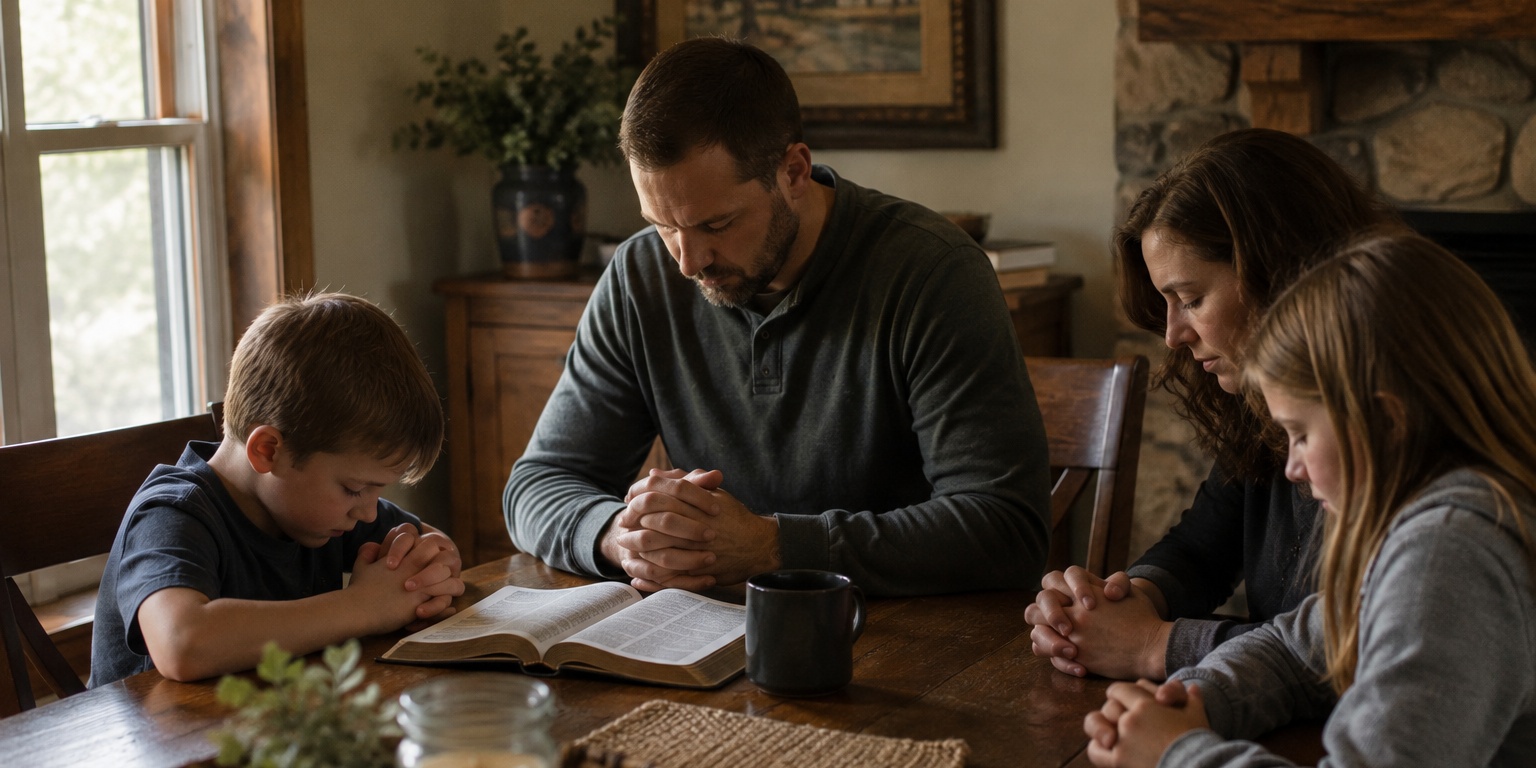
And that may be no more true than in the area of spiritual disciplines, particularly in our call as men to be the spiritual leaders in our households. In this short article I want to focus on just one very simple, but maybe most effective, way to exercise spiritual leadership in the home: family worship. By family worship, I mean the regular gathering of those in your household for the express purpose of worshipping God by reading the Scriptures, praying, and singing together.
What follows is structured around three questions concerning family worship: 1) Am I required to do family worship? 2) What does family worship look like? 3) Why is family worship so often neglected?
Am I Required to Practice Family Worship?
The answer to this question is yes and no.
Yes, there are examples of family worship in the Bible. You can think of Joshua’s famous line: “As for me and my house, we will serve the LORD.” You can think of Jacob in Genesis 35, who leads his entire household to put away false gods and serve the living God. Yet notice that none of these examples constitute a direct command in the Scriptures.
And that is why the answer to this question is also no. Nowhere is the specific act of family worship, as I have defined it above, commanded in the Scriptures. However, there is an asterisk next to the “no” part of this answer. And that asterisk takes you to a multitude of Scriptural texts that speak to the more general responsibility to lead and teach your family to love and obey God. Here’s just a few of these texts:
Deuteronomy 6:4–7
“Hear, O Israel: The LORD our God, the LORD is one. You shall love the LORD your God with all your heart and with all your soul and with all your might. And these words that I command you today shall be on your heart. You shall teach them diligently to your children, and shall talk of them when you sit in your house, and when you walk by the way, and when you lie down, and when you rise.”
Psalm 78:1–4
“Give ear, O my people, to my teaching; incline your ears to the words of my mouth! I will open my mouth in a parable; I will utter dark sayings from of old, things that we have heard and known, that our fathers have told us. We will not hide them from their children, but tell to the coming generation the glorious deeds of the LORD, and his might, and the wonders that he has done.”
Proverbs 22:6
“Train up a child in the way he should go; even when he is old he will not depart from it.”
Ephesians 6:4
“Fathers, do not provoke your children to anger, but bring them up in the discipline and instruction of the Lord.”
Ephesians 5:25–26
“Husbands, love your wives, as Christ loved the church and gave himself up for her, that he might sanctify her, having cleansed her by the washing of water with the word.”
Now, my question in light of these texts is this: How do you practically obey those general commands? There are a hundred different answers. As Deuteronomy 6 clearly teaches, this job of teaching the children is an “all of life” activity, for you must teach your children “when you rise and when you walk by the way and when you lie down.” So yes, it is possible to faithfully obey those commands without “doing family worship.” But what I want to argue is that family worship may in fact be both the simplest and most effective way to faithfully obey those general biblical commands.
Throughout church history it was assumed that conducting some form of regular family worship was an ordinary responsibility of all Christian men. Space does not permit me to illustrate but simply to list for you a small sampling of such men: Tertullian, John Chrysostom, John Knox, Martin Luther, Richard Baxter, Matthew Henry, Jonathan Edwards, John Paton, Charles Spurgeon, Martin Lloyd-Jones, John Piper, D. A. Carson—to name just a few. All men who understood family worship as part of their job description as the head of their household.
The Second London Baptist Confession (1689) clearly speaks to this responsibility of family worship in Chapter 22, Paragraph 6:
“…but God is to be worshipped everywhere in spirit and in truth as in private families daily, and in secret each one by himself…”
Further, commitment to family worship is a clear part of the promises we make in our own church covenant:
“We will engage in private worship at home, and will uphold the great duty of biblically training our children, and those under our care, for the service of Christ and the enjoyment of heaven.”
One of the reasons I love this statement from our church covenant is because it always re-calibrates my understanding of my job as a father. My fundamental job is not to raise smart and moral children who get a good job and become valuable contributors to western society. Though not unimportant, my more basic goal is to raise my boys into men and my girls into women who are ready to serve and enjoy Christ in this world and the next.
So, is family worship required? Technically, no. But if this is not a regular practice in your home, then I would encourage you to ask yourself this diagnostic question: How am I doing in leading my family spiritually? What reason do I have for not establishing a healthy rhythm of family worship?
What Does Family Worship Look Like?
The Content of Family Worship: Read, Pray, and Sing
Read, pray and sing! That’s it. It isn’t special. It’s simple, ordinary and powerful.
Read a passage of Scripture. If you don’t do anything else just commit to reading the Bible with your family. As you read, seek to engage your family with the text. Have your children read a portion of the text. Explain to them what a word means that they might not understand. Tell them one thing this passage teaches them about Jesus or about living the Christian life. Ask one or two comprehension questions. Ask your children if they have any questions. You don’t have to preach a sermon. Your goal is to expose your family to the word of God.
Pray. Assign one idea from the Scripture you read to pray about. Teach your children to pray the Lord’s Prayer. Pray through the church membership directory. Have each person pray for the person on their left.
Sing. Just do it! You don’t have to have a good voice and you don’t need accompaniment. Our TCK Hymn Harmony hymnal was designed to be sung by untrained voices—ask us for a copy. Sing just one verse, sing a song everyone knows, but sing something.
Read, pray and sing. That’s it. Matthew Henry famously said: “They that pray in the family do well; they that pray and read the Scriptures do better; but they that pray, and read, and sing do best of all.”
Advice for Establishing Family Worship: Brief, Regular, and Flexible
Brief. Family worship is not a church service. My family worship with a five-year-old and a three-year-old is rarely (if ever) more than fifteen minutes. As your children grow you can gradually expect more out of them. Even if it is just you and your wife, so much more is accomplished with regularity than with length. For any family, brevity will most often bear the fruit of consistency.
Regular. Find a time that you can actually commit to. Morning, dinner, bedtime. The time doesn’t matter. The point is you need to pick a time where the entire family is together or you won’t be able to keep up the habit.
Flexible. If my family is out late or we have dinner at someone else’s house then I often will put our children to bed without doing family worship. While flexibility certainly can become an excuse for inconsistency, most modern Christians don’t need encouragement to be more flexible. Rather, they need encouragement to buckle down and give themselves to building healthy spiritual disciplines, especially that of family worship.
Why Is Family Worship Neglected?
If family worship is so important and so simple, then why has it fallen by the wayside in the Christian life today? Here are what I perceive to be some of the most common reasons family worship is a neglected practice in the church today.
Lack of examples. Think about your own life—did you grow up in a home that regularly practiced family worship? Most did not. Most Christians will never hear a talk or a sermon application on this topic because it’s not even on the radar of many pastors. If you’re handicapped by a lack of example, ask to join a family in the church that you know makes this a regular practice. The more the merrier!
Guilt, shame and inadequacy. Many men don’t engage in family worship because they view themselves to be spiritually incompetent. Yet, God does not call the equipped he equips the called. If you are a Christian man and God has given you a family, then he has given you what you need to lead them spiritually. I’m not asking you to preach a sermon. I’m simply asking you to read the Bible, pray and sing with your wife and children.
Busyness. While busyness is real, it is rarely unique. In other words, everyone is busy. The reality is if you have 15 minutes a day to do anything (like eat a meal) then you have time to do family worship. If you don’t have 15 minutes a day with your entire family together, barring extenuating circumstances, then you should probably re-evaluate your life schedule.
Children’s behavior and/or age. Many men excuse family worship because they think their kids can’t sit still long enough. That may be true, but the answer is not to neglect family worship but to buckle down on discipline. Other times, a family reasons that the age difference between their children prohibits meaningful family worship. Historically speaking, this has never been an impediment to regular family worship. There are simple and creative ways to include children of all ages.
Shallow and irregular communion with Christ. Lastly, and maybe most importantly: you cannot give to your family what you are not getting from Christ personally. If you are not daily seeking the Lord in prayer and in his Word, don’t be surprised if you have nothing to give your family.
Conclusion
Brothers, take seriously God’s calling on your life as the spiritual leader of your household. Be confident that God has equipped you in Christ, and through the church family, to lead your family in worship. Give yourself to the daily work of planting gospel seeds in your home, then pray that God would use those brief, ordinary, daily moments to bear the fruit of true living faith in Christ. Who knows, God may be pleased to use your ordinary faithfulness to raise up the heroes of the church in the ages to come.
Resources for Family Worship
Books on Family Worship
- Family Worship, Donald S. Whitney
- A Neglected Grace: Family Worship in the Christian Home, Jason Helopoulos
Children’s Bibles & Resources
- The Biggest Story Bible Storybook, Kevin DeYoung
- The Big Picture Story Bible, David Helm
- The Kingdom of God Story Bible, Lithos Kids
- The Illustrated Westminster Shorter Catechism, Andrew Green
- Little Pilgrim’s Big Journey, Lithos Kids
Hymnals
- TCK Hymn Harmony (ask us for a copy)
- Hymns of Grace, by Grace Community Church and The Master’s Seminary
- The Sing! Hymnal, by Keith and Kristyn Getty