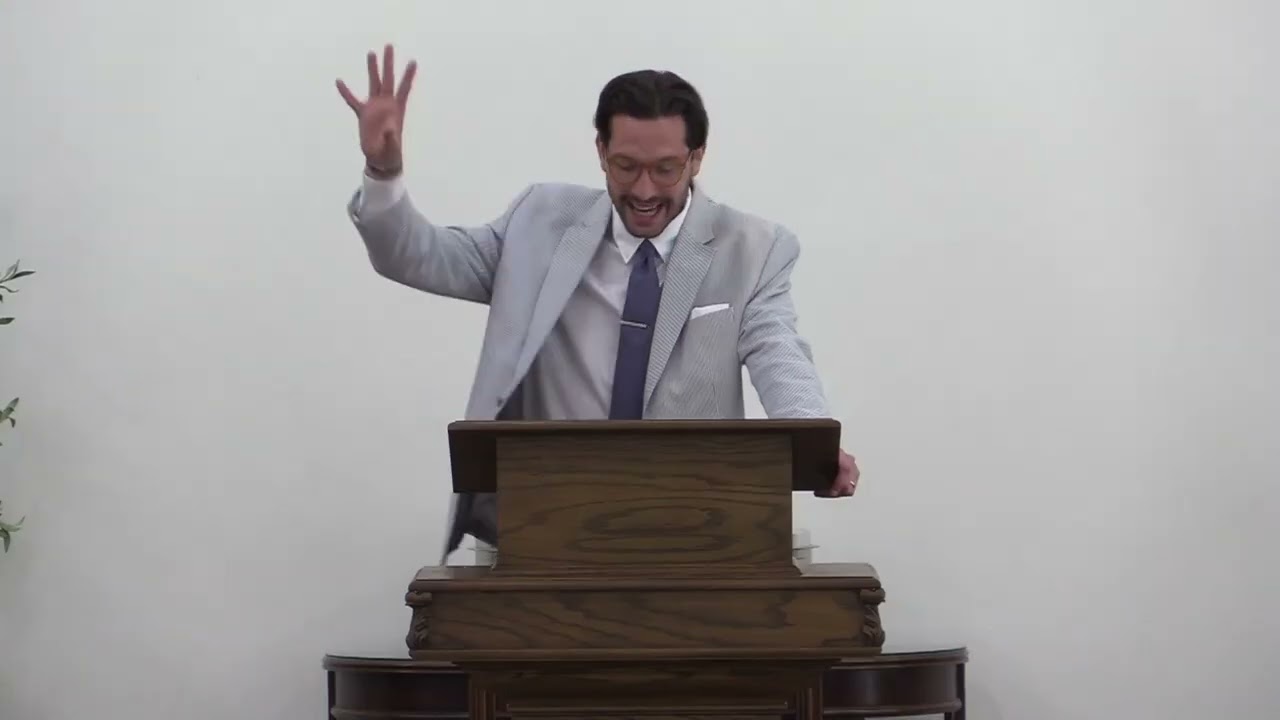
In this sermon on John 8:12–20, Zack DiPrima unpacks Jesus’ bold declaration, “I am the light of the world,” showing how Christ alone reveals truth, exposes sin, and brings life to those who follow Him. Set during the Feast of Booths, where great lights illuminated Jerusalem, Jesus claims to be the ultimate and divine source of spiritual light. The sermon contrasts the false hope of human progress with the reality of mankind’s spiritual darkness, emphasizing the necessity of regeneration and a transformed heart. It also highlights the witness of the Father to the Son and calls believers to walk in the light through repentance, faith, and a life that reflects Christ to a dark world.
This sermon is also available on Spotify and Apple Podcasts.
If you have your Bibles with you, please turn them to John chapter eight. We’re moving from John seven to John chapter eight. This morning I’m going to be reading verses 12 through 20. That’s our text today.
I need to address a housekeeping matter. I think I emailed all the church members about this earlier this week, but you’ll notice if you’ve been keeping up with things. Last week we got through John chapter 7:52. Most of your English translations are then going to have John 7:53 through John 8:11. And I just looked at this in one of the pew Bibles, and it’s in brackets. And most of our manuscripts or most of our translations will have some sort of note here that says something along the lines.
This is what the Pew Bible says. The earliest manuscripts do not include John 7, verses 53 through John 8:11. I’m rather simplistic about this. I’ve studied this issue a few times throughout my life, but my view—the view of the elders—is consistent. We accept what is the consensus opinion. That is, it is most likely, it appears well as a matter of fact, those verses of John 7:53 through John 8:11, which includes the woman who’s caught in adultery—a wonderful story—is not included in the earliest manuscripts we have of the scriptures. It doesn’t appear until later manuscripts, I believe in the fifth century. I sent an article to the church. You can look into that with more thoroughness. I’d be happy to send that to you if you’re not a member of the church, and to share that with you.
For some people this—I don’t feel this way, but for some people this can shake your confidence in the Word of God. It actually gives me far more confidence in the Word of God. There are probably about a half dozen examples like this in your New Testaments. In the English translation of the Bible that you have, this is probably the longest set of verses. The end of the gospel of Mark is like this. What’s I find reassuring about this? Every time I look into the issue of the reliability of the scriptures—like, can we know with certainty that the manuscripts that we have represent the original letters and writings of the original authors?—there really isn’t a more certifiable fact in human history than that the Bible we have is accurate. And the more you just put kerosene on that fire, you’ll just see it more and more. There is no more obvious truth of human history. Even secular scholars pretty much universally acknowledge that the Bible is at least authentic. Now, they might not think it’s authoritative as we believe, but it is authentic. There aren’t very many challenges to that.
Another thing that you should know is that this account of this woman caught in adultery, and any of these textual discrepancies that we see in the New Testament, none of them relate to any sort of major head of doctrine, and none of them are in conflict with any teaching of the Bible. So they pose no threat. Even if they were a part of the original manuscripts, they wouldn’t be adding a new teaching to the Bible.
The last thing I’ll just say about this account of the woman caught in adultery in particular is it’s believed most scholars would assume that this probably actually did happen, and this was part of the oral tradition that was preserved by many, and probably was an event that happened in Jesus’ life. I can’t say with any expertise as to whether or not that’s true, but it’s very possible that this thing we see happen in verses 7:53 through 8:11 did in fact happen in the Lord. However, it was not preserved by the author, by the Apostle John. Therefore, if I can’t with certainty know that what I am preaching is the holy Word of God, I’m not going to preach it. I might open a sermon with an illustration from American literature, but I don’t preach American literature. The same with texts that we don’t know for certain are part of the Bible.
Okay, you can log all that away for now.
In John 8 verses 12 through 20, this is happening right after—in the same context of the Feast of Booths. The Feast of Tabernacles was now, as I read verses 12 through 20.
Again Jesus spoke to them, saying, “I am the light of the world. Whoever follows me will not walk in darkness, but will have the light of life.” So the Pharisees said to him, “You are bearing witness about yourself; your testimony is not true.” Jesus answered, “Even if I do bear witness about myself, my testimony is true, for I know where I came from and where I am going. But you do not know where I come from or where I am going. You judge according to the flesh; I judge no one. Yet even if I do judge, my judgment is true, for it is not I alone who judge, but I and the Father who sent me. In your law it is written that the testimony of two people is true. I am the one who bears witness about myself, and the Father who sent me bears witness about me.” They said to him, “Therefore, where is your Father?” Jesus answered, “You know neither me nor my Father. If you knew me, you would know my Father also.” These words he spoke in the treasury, as he taught in the temple; but no one arrested him, because his hour had not yet come.
Let’s go to the Lord in prayer.
Father, as we have already seen in worship today, and we know from our own experience, you are God and we are not. And you dwell in infinite, incomprehensible, unapproachable perfection. Lord, our countenances could not withstand the light of your presence, and yet your beloved Son is the light of the world. He shines on every page of your scriptures. He has revealed himself to us. But help us to see him.
Lord, may everyone in this room follow him and therefore not walk in the darkness, but, Lord, that we would have Jesus, we would know Jesus, we would walk with Jesus, that Jesus Christ would dwell richly in our hearts through faith in him. Bind us to the light. Help us to understand your word. Now change us. We ask in Jesus’ name. Amen.
Nearly every generation has had apostles of progress. Alfred, Lord Tennyson, he wrote in his poem *Locksley Hall*, this is in 1842: “For I dipt into the future, far as human eye could see, saw the vision of the world, and all the wonder that would be; till the war-drum throbbed no longer, and the battle-flags were furled in the Parliament of man, the Federation of the world.”
Tennyson imagined a world of unfettered progress, where a new order would usher in world and global peace. And he wrote that in the Victorian era, that era between 1830 and maybe 1910, and this is a period often referred to as the Victorian era, which happens after what’s often referred to as the period of the Enlightenment.
Enlightenment. That phrase means something and signals something to our minds. Friends, the promise of the Enlightenment—think years 1650 through 1800—has always been that if mankind can cast aside the chains of tradition, religious belief, and trust alone in reason, science, and human autonomy, then and only then he will be met with unbroken progress and flourishing. That’s the promise of the Enlightenment.
And there have been many apostles of this promise of progress ever since. Recently, the author Steven Pinker celebrates the vision of the Enlightenment, and in a book titled *Enlightenment Now*, he argues that the Enlightenment has furnished humanity with the tools for unprecedented progress. Earlier voices, unlike Pinker—people like Voltaire and Rousseau—they argued for the destruction of religion itself. And if we could only do that, shed the code of tradition, well, then we could have freedom.
The spirit of the Enlightenment did not end in the 1800s. Rather, the apostles of progress have prevailed in every generation since. Christians have the Apostle Paul. Communists have the apostle Karl—the ideas of Karl Marx and the communist revolutions. They preach progress. People like Gore Vidal and Margaret Sanger in the sexual revolution, and more presently, Elon Musk and Sam Altman in the Technological Revolution. Progress. Light from darkness. Forward movement. Evolution. This is the mantra of the hour.
Yet, brethren, this ballad of progress is as old as Babel. There in the land of Shinar they all said, “Let us build a tower to heaven. Let us make a name for ourselves. Let us make ourselves equal with God.” See, brethren, the problem with the promise of Enlightenment and these apostles of progress is that they, as mankind, see themselves as the center of life. Man sees himself as the measure of all things. Man says, “I am this dark world’s light.” Yeah, we got some problems, but we are the solution. Mankind is the light.
Nothing can be further from the truth. In reality, Jesus tells us that we are darkness without him, and only through following him we can no longer walk in darkness, no longer be blind, but we can have the light of life. This is the promise of our text.
I have three points this morning. They all relate to verses 12 through 20.
Point number one: the proclamation of the light.
Point number two: witnesses to the light.
Point number three: life in the light.
We’re going to spend most of our time on point number one, really just looking at verse 12. It’s such a tremendous concept and verse that towers over the rest of the chapter. We want to give it due attention, and then we’ll look at the rest of the text in the second point, and we’ll move through that actually rather quickly. And then that last point, life in the light, is going to be us considering applications and implications of this truth: the proclamation, witnesses, and life in the light.
Point One: The Proclamation of the Light
Please look at verse 12. Again Jesus spoke to them, saying, “I am the light of the world. Whoever follows me will not walk in darkness, but will have the light of life.”
Four things we’re going to see about this proclamation. First the context, then the nature, then the need, then the condition. Context, nature, need, condition.
What’s the context of this proclamation of light? Verse 12. Friends, it looks both backwards as well as forward in the narrative of John. Jesus, when he says, “I am the light of the world,” he’s actually looking backwards and somewhat presently, and he’s also peering ahead to things and acts of redemption that are about to unfold.
What do I mean? Okay, first it looks backwards. Jesus’ proclamation of being the light of the world points back to the Feast of Booths, which we’ve been examining these last several weeks as we’ve been moving through John 7. The Feast of Booths or the Feast of Tabernacles is still going on, and I believe that this is actually in the evening of what we’ve just read. So it’s in the context of this great declaration that Jesus has already made: that “I am the water of life. All those who thirst, come to me, and the Holy Spirit will open rivers of water. They’ll flow through your heart.”
All those things he has in mind—the tabernacle or the temple crowd, these people that are coming into town to Jerusalem for this feast. So it’s looking backwards at that feast. And I didn’t get to talk about this two weeks ago, but that promise that Jesus is the water of life actually has significance related to the feast itself. In the feast, on the last day, there were ceremonies of water pouring. In fact, that would be happening throughout the Feast of Tabernacles. And as they’re having these rites of water pouring throughout the Feast of Booths, Jesus is saying, “You want water? I’m the true water that satisfies. I will satisfy you forever.”
Similarly, each evening of the feast, there were lights in Jerusalem, for massive lamps were lit in the temple court, illuminating the whole city. So ancient sources, they attest that this went on every night of the Feast of Tabernacles, with the light from the temple area shedding its glow all over Jerusalem. So Jesus is likely speaking in the evening of the feast, as in the court of the temple, as there are these great lights that illuminate all of Jerusalem.
Our culture has attachment to lights. Our holidays have attachment to lights, right? Christmas—all the lights of Christmas. We enjoy the lights around Christmas time. New Year’s Eve—flashing fireworks. We love light. This is an aside, but July 4th is a big day for me because I love my nation. And it’s not every day my nation turns 250 years old. So my goal this year is to have maximal fun and festivities on July 4th. But what do we look forward to on July 4th? We look forward to the fireworks. Right? Okay. Do you like fireworks?
Now imagine if you all are all over at my house for a party on the 4th of July. We see the fireworks begin to go off, and then there’s a pause in the fireworks and I say, “Everyone, I am the fireworks. Look to me, the true fireworks. You want lights on the fireworks?” Well, I hope you’ll be talking to the elders. We have some concerns about Pastor Zack, and I hope you fire me. I hope you would put me away. Honestly, that would be a sign of mental illness. It would be a problem.
Jesus is actually doing something like that. It’s massive lights in the temple. He says, “You want lights? I am the light of the world. Those who follow me, they don’t walk in darkness. Rather they have the light of life.”
Jesus, when he says he’s the light of the world, he looks backwards to the feast that’s been going on, presently at the lights right there in the temple. He also looks forward. It anticipates Jesus’ miracle of giving sight to the man born blind in John 9. He doesn’t just give physical sight to that man. He graciously, clearly gives eyes to his soul. I want to preach that right now, but we’re in John 8. I’ll stick to John 8. Right? That’s the context of the light.
Consider secondly, under this heading, the nature of the light. Jesus says he’s the light of the world. Now what does that mean? And why is it so offensive to the Jews? It’s an audacious assertion for many reasons. First, it is yet another way he asserts his divinity, and more importantly, he asserts his supremacy and makes himself equal with God.
Now, light has relevance in every religion. Every religion has concepts of light, and light illuminates, and you want to have light. It’s always a positive thing in every major religion, especially in Judaism. Listen to how light is spoken of throughout the Old Testament and how it is associated with God and His beneficence, and God and His Word, and God and His blessing. So it’s associated with light, with God Himself.
Psalm 27:1: “The Lord is my light, Yahweh is my light and my salvation; him shall I fear. Yahweh is the stronghold of my life; of whom shall I be afraid?” And here Jesus is saying, “I am the light of the world.” That’s Yahweh is the light.
We see it in Numbers, that blessing. You’ve heard this probably many times in your life. “The Lord bless you and keep you; the Lord make his face to shine upon you and be gracious to you; the Lord lift up his countenance upon you and give you peace.” The light of God’s countenance brings with it blessing. It brings with it peace and refuge. And you want to be close to the light of God.
We see it in the prophets. The light is a messianic emissary of God’s salvation. Literally, this is what the prophets say about the Christ. The Lord says, “I will make you as a light for the nations, that my salvation may reach to the ends of the earth.”
And then, of course, Psalm 119 makes it so clear that the light of God’s Word, logos, is a lamp and a light to the path of the righteous. “Your word is a lamp to my feet and a light to my path.”
This light—it brings with it peace. This light—it brings with it salvation to the ends of the earth. This light is a guide to our path. This light is the Lord Himself, and it’s a stronghold. And now Jesus says, “I am the light. I am that perfect, pure, explosive light. I am the light and lamp that illuminates the path of the righteous. I am that light that rises like the sun in a cloudless sky. I am that light who joins upon you and gives you peace. I’m that light of the nations, bringing salvation to the end of the earth. I’m the light that brings life. I’m the world’s only light. And whoever follows me must not, shall not, will never walk in darkness, but will have eternal life.”
He’s not just going to have a relationship with the light of life. He will actually have it. He will possess light within himself. Jesus makes a stunning proclamation here of his own supremacy. It’s all about him. He is the light of the world. And this is offensive. It’s offensive to unbelievers because he’s asserting his supremacy. But light is offensive for another reason. It’s offensive because it reveals their need for him.
The reason why Jesus being the light of the world is so deeply offensive to unbelievers is because the light exposes the light, reveals the dark, capacious need for Christ. Which leads to this next point: the need for light.
You see, in the context we’ve seen the nature; now, the need. Jesus as the light of the world reveals the darkness of the world. It’s everybody. You need to comprehend this, especially if you’re not that familiar with Christianity. Like this is one of the big things about the gospel. The gospel is not a contextless message. Let me say that differently. It’s not a message and good news without context. In other words, the good news of the gospel cannot shine forth and be of any meaning to you unless you comprehend the bad news. And the reason why this is such a penetrating truth, that Jesus is the light of the world, is that he reveals our darkness. He reveals our depravity, he reveals our sickness and our need for him. He reveals our sin. That is the meaning of the light.
The light of Christ means nothing until you comprehend the terror of darkness. And this is why so many of these texts and so many of these authors that prophesy the promise, the coming of the light, they say it’s in the context of great, grave darkness.
I quoted the prophet Isaiah a moment ago. Two texts that this is a cross-reference for: Isaiah 9. “The people who walked in darkness have seen a great light; those who dwell in a land of deep darkness, on them has light shone.” If we’re walking outside in a cloudless day in the summer and I shine a flashlight, it means nothing. But if we’re in the dead of night, there’s no power grid, and I shine a torch—oh, it’s going to ablaze. And you’re going to see so much because it’s revealed and it pierces through the darkness.
Isaiah 60: “Arise, shine, for your light has come, and the glory of the Lord shines over you. For look, darkness covers the earth, and total darkness the peoples; but the Lord will shine over you, and his glory will appear over you.”
And Jesus says, “I am that light. I’m coming into this dark, sin-cursed world.” It’s not a physical darkness. Please understand. It’s not a physical darkness. It is a moral darkness. It’s a sinister sickness of the soul. Which is why when Paul reflects upon salvation, he can say this in Titus 3, talking about the appearance of Christ our Savior—that *epiphaneia*, the Greek word, the epiphany of grace. It happens in the context of being dead in sin.
He says, “For we ourselves”—and listen to this. This is the Apostle Paul, one of the most tedious law-followers you will ever meet. And he’s lumping himself in this same sick group of sinners. He says, “For we ourselves were once foolish, disobedient, led astray, slaves to various passions and pleasures, passing our days in malice and envy, hated by others and hating one another.” That’s your biography outside of Christ. I don’t care if you never remember a time where you did not receive the gospel and believe on Jesus. This was you, theologically, at least at some point: hated by the world, hating one another, outside of Christ.
Or as even more clearly than this, Ephesians 2: “You were dead in the trespasses and sins in which you once walked, following the course of this world, following the prince of the power of the air, the spirit that is now at work in the sons of disobedience.” Yes, you were a slave to your own passions, so you actually did what you want. You signed on that line. You signed your death sentence. You actually wanted the wicked dark works of the world, he says, “among whom we all once lived in the passions of our flesh, carrying out the desires of the flesh and the mind, and were by nature children of wrath, like the rest of mankind.”
I just said this, but I need to say it again. We are not mere captives of the darkness outside of Christ. We are not mere slaves to darkness. We are in love with the darkness. You need to understand the sinner’s nature with sin. Do you know why people can reject the light of Christ? Well, they reject the light of Christ because in order for them to receive the light of Christ, it has to supplant their deep love affair with darkness.
This is exactly what Jesus says in John 3. He says, “This is the judgment: the light has come into the world”—and you think, “Praise God, oh, that sun is shining on sinners. They can receive the light.” What does Jesus say? “And people loved the darkness rather than the light, because their works were evil. For everyone who does wicked things hates the light and does not come to the light, lest his works should be exposed.” They cower away from the light because they do not want their sin exposed. They don’t want to appreciate the darkness.
Jesus says people reject him because their works are evil, but the works are evil because they love darkness rather than light. People do, brothers and sisters. They do what they want to do. People reject Christ because they have a sin problem, and the sin problem forever and always is a love problem. The problem is the heart. It’s that resident of affections that assigns worth in your life. That’s what your heart is always doing. It’s making value judgments, saying, “I love my wife, I love my kids. I love my success. I love my career. I love man.” It’s saying, “I love these things. They’re valuable to me.” And it’s always comparing those things and it’s measuring those things and it’s triaging those things compared to other desires.
And Jesus says, “The reason why people don’t receive me is I’m low on the totem pole. They love their sin. They love other things beside me.” People reject Christ because they have a sin problem. The problem is the heart. It’s always been the heart. This is why Jesus, friends, he’s constantly after the heart. He can say to Nicodemus, “Yeah, yeah, you keep the law. You’ve got to be born again. You need new life in you. You need that new covenant promise that says, ‘I’m going to take the heart of stone from you, and I’m going to give you a heart of flesh.’ You need a heart transplant. You need another way to love me. You need the Spirit of God to regenerate you. You must be born again. You don’t just need moral reformation. No, you need regeneration. You must die and become born again. You need a new spirit that obeys Christ. You need a gift of a heart that desires Christ. You need a new nature that loves Christ.”
Brethren, Jesus wants to be treasured and loved, and every rejection of him is ultimately blasphemy. Understand this: every rejection of Jesus Christ—which isn’t just saying “I hate Jesus”—failure to love him is blasphemy because he is a treasure of ultimate worth, and he has designed you to receive him and to know him and to love him.
This is imperative to understand if you think your sin is just not that bad. Rejection of Christ says so much more about the rejection than the thing rejected because it reveals your moral bankruptcy. The Lord Jesus is a Savior and treasure of infinite worth. He’s the Son of God. He’s the Son of Man. He’s the King of Kings. He’s the Lord of Lords. He’s the Alpha, the Omega, the beginning, middle, and end. And the sinner says, “I’ll take the darkness, thank you. I’ll take the world. I’ll take fleeting pleasures. I’ll take my toys and trifles. I’ll take my career and children. I’ll take man’s approval or my own autonomy. Jesus may be good for you, but I’m just doing fine without him.” It’s blasphemy. It’s rejecting the light—the light that is so clearly offered to you.
Jesus doesn’t just say “I am the light” as a point of vindication, though he does vindicate himself by being the light. He says, “I am the light of the world” to entice, to invite you. “Whoever follows me will not walk in darkness, but he will have the light of life.”
Which is why you might be thinking, “Do I have this light? I think I need this light. I want to know if I’ve ever had this light.” Well, that’s why you need to understand the condition of the light. Did you notice? The text says, “Whoever follows me will not walk in darkness, but will have the light of life.” As Bible readers, you just have to pay attention to those words like “whoever,” “whosoever,” “whichever,” or “the one who does.” That’s telling you who the people are that receive the light or the blessing of the promise offered.
Because here’s the problem: so much of the world will hear that Jesus is the light of the world. And they say, “That’s great. I love light, and this world is a dark place. It’s going to hell in a handbasket. We need light.” Jesus is not the light of the world for everyone now. Everybody benefits from the presence of his light. I mean, just this country itself benefits from the light of Christ. There’s common grace. I’m not talking about that.
To experience the light of life—which is the bullseye promise of John, eternal life with him, immortality—to experience that type of fellowship with God, there’s a condition. It’s following him. “Whoever follows him will not walk in darkness but have the light of life.”
So there’s a burning question: what does it mean to follow Jesus? Everybody needs to understand this. How does a person become a Christian? A person becomes a Christian through faith and repentance. Faith is wholesale trust in Jesus. It’s synonymous with Bible words that you see like “trust” and “believe”—all mean the same thing. Repentance is like the other side of the coin, which means you actually turn away from sin.
I explain this all the time because I’m helped by it. I’m going east. Jesus is going west. That means to follow Jesus. If he’s passing me going west, what do I have to do? I have to turn away from east and I start walking west. That’s following Jesus. That’s faith. That’s believing on him. That’s turning away from the darkness, that’s turning away from my life and my sin. And it’s following him. I’m going where Jesus goes. I’m trusting him. I believe in him.
Following Christ is just another way of describing faith. J.C. Ryle says this: “To follow Christ is to commit ourselves wholly and entirely to him as our only leader and Savior, and to submit ourselves to him in every matter, both of doctrine and practice. Following is only another word for believing. It is the same act of soul, only seen from a different point of view. As Israel followed the pillar of cloud and fire in all their journeys, moving whenever it moved, stopping whenever it tarried, asking no questions, marching on in faith, so must a man deal with Christ. He must follow the Lamb whithersoever He goeth.”
This is the proclamation of the light.
Point Two: Witnesses to the Light
Verse 13. The Pharisees said to him, “You are bearing witness about yourself; your testimony is not true.”
Now there’s a reason why this narrative originally happened right after verse 52. It’s in the same flow of the narrative. And no, I think it’s probably hours later. It’s still narratively in the context of chapter 7. These verses neatly follow Nicodemus’ question in verse 50–51. Nicodemus asked, “Does our law judge a man without first giving him a hearing and learning what he does?” And here the Jews, they say, “You’re bearing witness about yourself, and there’s just you here. You need another witness. Therefore we can’t affirm your testimony.”
Verse 14. Jesus replies, “Even if I do bear witness about myself, my testimony is true, for I know where I came from and where I am going. But you do not know where I come from or where I am going. You judge according to the flesh; I judge no one. Yet even if I do judge, my judgment is true, for it is not I alone who judge, but I and the Father who sent me.”
Now, just some housekeeping, clarifying. When Jesus says he judges no one, he’s not saying that he doesn’t make moral judgments. That’s not what he’s saying. He’s saying more or less, “I don’t judge the way you judge.” And I know it’s not saying that he doesn’t make moral judgments because most of the gospel narratives are Jesus making moral judgments. I mean, he’s constantly—Jesus is pretty judgy, actually. He’s constantly making moral judgments. And there’s a reason why that text in the Sermon on the Mount “do not judge” is the most abused text in the entire world. I mean, people rip that out of context and don’t understand what it means. Another sermon for another day.
Neither is he saying that he doesn’t finally judge anyone. I know this because, as I say, the Bible makes sense. And what is he saying? In John 5 he says that the Father judges no one, but has given all judgment to the Son. So there is a type of judgment that Jesus has that is a final judgment. The main point, what we need to understand is that Jesus is saying something in this text closer to what he says in John 3:17. John 3:17 he says, “God did not send his Son into the world to condemn the world, but in order that the world might be saved through him.”
So what Jesus is saying is like in John 3, his emphasis is on the main mission of salvation. So Jesus came into the world. It doesn’t mean he isn’t going to have a final work of judgment in the new heavens and the new earth. We say in the Creed, “He will come in glory and power to judge the living and the dead.” It’s eminently true according to the Bible. So, friends, make no mistake, Jesus will come again to judge. But the Lord’s larger argument is that even though he bears witness about himself, the Father bears witness to his claims.
This is why he says, “I know where I came from and where I am going, but you do not know where I come from or where I am going.” Jesus says, “I came from my heavenly Father. I’m going to go back to my heavenly Father. And you’re not going to go there because you don’t know him.” So Jesus is saying to the Pharisees, he’s saying, “You fake a familiarity with God, but you actually don’t know him.” Jesus is a citizen of a nation to which they are only foreigners.
Jesus also reiterates that their judgment is superficial. He says, “You judge according to the flesh.” And that’s a callback to the beginning of John 7. You remember at the feast, many of the Jews, they marveled at his teaching, but they wondered, “Where did he have his training? Where did he have his education?” Others, legalistically, maligned him because he healed a man on the Sabbath. And Jesus’ message is, “Stop judging by appearances. Stop judging by the eye. Stop judging by what you want. Stop judging by what you think is true. You need to judge with right judgment.”
And then in verse 17 he says, “In your law it is written that the testimony of two people is true. I am the one who bears witness about myself, and the Father who sent me bears witness about me.” He’s saying, “I’m witness number one. My Father is witness number two.” He makes a similar argument in John 5. He says, “If I alone bear witness about myself, my testimony is not true. But there is another who bears witness about me, and I know that the testimony he bears about me is true.”
They’re not just mad because he says he has another witness. They’re mad because he says the other witness is God, and he says that other witness is his Father. This is why they sought all the more to kill him, because he made himself equal with God. Jesus claims absolute unity with his Father. He does not merely represent the Father; he works with him. What the Father does, the Son does. The Son creates, the Son redeems, and there is no division between them, no gap between divine will and action. In every act of providence, judgment, and revelation, the Son does exactly what the Father does and nothing beyond.
And it’s this issue of paternity—who’s your father, Jesus?—that will dictate the rest of John 8. This discussion of whose father is who? Who’s the father of the Pharisees? Who’s the father of Jesus? This is the witnesses to the light.
Point Three: Life in the Light
And here we’re just asking, what do we do with all this? Particularly, what does it mean to be people of the light? What does it mean to have the light of Christ?
Verse 12 says, “I am the light of the world. Whoever follows me will not walk in darkness, but will have the light of life.” Jesus says, those who follow him, they don’t walk in darkness, but they have something. They have this light.
So, brethren, I want to close with three implications for the light of life in the Christian life. I want to emphasize how being a lover of this light and finding your life in this light affects Christian experience and community. Three things.
First, brothers and sisters, life in the light clarifies. Life in the light clarifies part of the mission of a faithful church, the people of God. This community of elect exiles is actually to expose the sin of the world, not accommodate it. Now, if you think, “Well, what about arson?” I’ll get to that later. But part of the church’s mission in the world as a people of the light, as a lamp set on a hill, is actually to show an antithesis between the light and the darkness. There’s to be a difference. This would be a line of division. This would be something different about the people of God compared to the people of the world.
That’s why one of the blazing questions in Christian experience is, even if you’re in a relatively moral society—which I think ours still is—you should be asking, “What distinguishes me from my unbelieving neighbors? What distinguishes the people of God at Trinity Church from good-standing citizens in Cobb County?” There ought to be an antithesis, no matter how much common grace has affected our culture. There should be a difference between the church and the world.
But sadly, the church so often accommodates sin and desires resemblance and likeness to the world in our pursuit of evangelism. We must not chase the world’s approval. The point of the light of the world is to deliver from the darkness of the world. Meanwhile, many of the church’s errors have arisen from this backward instinct to win the world by resembling it.
You could call this Jungle Book ecclesiology. King Louie—what’s he say to Mowgli? “You. I want to walk like you, talk like you, I want to be like you.” The king of the jungle wants to be like man. So often the church is doing that with the world. We want to be like the world. And we want to win the world by showing the world we’re like you—not like we were once sinners, but like we’re cool like you. We’re with it like you. We’re not like those other bad type of Christians from your former experience. No, we’re with it. We’re cool. We resemble you. We’re not that much different. You don’t have to give that much up to follow Jesus Christ when nothing could be further from the truth.
We say we’re just like you. We sound like you. We live like you. We think like you. Our music will entertain you. Our message will soothe and comfort you. Our creed will affirm you. Brethren, that is not the message of Christ. That is not the message of the light. That’s total tripe, cosplaying as Christianity, and it is utterly powerless to transform a single soul.
No, we don’t save the world. We don’t reach the world by resembling the world. No, the faithful church tells the world we’re not the same. But we were once like you. Yes, we were blind. But now we see. Yes, we were lost. But now we’re found. I’ve been changed by the power of the gospel. The quickening ray of God’s power has broken the shackles of my sin. I’m now free from its bondage. I’m free to walk in true righteousness and holiness.
The people of God have been changed, and it’s the sight of that marvelous light that so often changes people. “I want what these people have. I know people in this church that have been converted just from listening to the hymns. They hear the singing of the people of God. And so I don’t know what this is, but I want this. I want to be a part of this. I want what these people have. It’s so authentic. It’s so true. They’ve been changed by this. What is—who is this Jesus Christ?”
We do not save the world by resembling the world. No. We have a message. Our message is one that exposes. Our message is the light of Christ. Our gospel is the same message Jesus preached: “Come as you are so you can see who you are so you can no longer be who you are. Follow me. Follow the Lord Jesus Christ. He breaks the power of canceled sin. He sets the prisoner free. His blood can make the foulest clean. His blood availed for me.” That’s the message of the church.
Brothers and sisters, let me just say this as a quicker aside before I move to the next point. This is one of the reasons why a church needs to do two things at the same time. A church always needs to be confronting the sins that are in the pew. So, part of the reason we gather on Sunday morning and sit under the Word of Christ preached and engage with God in Christian worship is we want our own sins to be discovered. We want our own sins to be exposed. We want to repent to the Lord, and we want to grow in conformance to the will and the mind of Christ. Do not hear me wrong. So much of Christian preaching and Christian teaching is for us to be changed, and to the sight of Christ we turn away from sin. That’s Christian experience.
But there’s been a problem, I think, in many evangelical circles where we think because it’s so important that we confront our own people’s sins, that it’s hypocritical or wrong to acknowledge the sins of the world. I don’t think anything could be further from the truth. That approach to the world is wrong for two reasons. First, we struggle way more with the sins of the world than you may realize. And the world is so often in the church, and people need to be taught, and people need to realize, “Oh, I am thinking like the world. I’m thinking like my former father, Adam. I’m thinking like my former father, Satan. And I need more and more to conform with the mind of Jesus Christ.”
Also, there’s something to the light of Christ that the church is the place that should make the world make sense. Like I hope when you gather with the people of God, you realize, “Yeah, this is where the world makes sense. We know what a man and a woman are. We know that children have dignity and worth. We seek to love our neighbors. People don’t. They don’t speak to each other with filthy speech like they do at my office.” The world—the church—is the place where the world makes sense. And I’m reminded what my life in Christ is. I’m formed each day anew in him, what it should look like in contrast with the world. And thus we need to be able to expose the sins of the spirit of the age.
Okay, enough on that. Life in the light clarifies.
Consider secondly, life in the light cleanses. Please turn to 1 John 1.
The light of life produces a walk in the light. To say it negatively: Jesus says, “Whoever follows me does not walk in darkness.” It cleanses the conscience and consecrates from sin. Here’s something to pray for this week: “Lord, would your light help me to walk more in my life with a clean conscience?” There’s just like nothing more important in the Christian life than having a clean conscience before God and before man.
But knowing the light of the world revolutionizes the Christian’s entire identity. So Jesus says this. And Paul rather says this in Ephesians 5: “At one time you were darkness”—he doesn’t even say you walked in darkness or you did dark things. You actually were darkness—“and now you are light in the Lord. Walk as children of the light.”
I mean, is there any more like cosmic sledgehammer to my life? I’m not darkness. I was darkness no longer. I am light because I have the light of life. I’m in Christ. I’m fast bound to him. And that changes everything. Changes how I treat my family, my spouse, my kids. It changes how I look at my career. It changes how I put one step in front of the other. It changes my fight with sin. My real, real, real fight with sin. It’s a fight. Because I’m no longer enrolled in the service of the enemy. I’m enrolled in the service of Christ. I’m a part of the army of the Lamb. Like, my whole identity is different. I don’t just go to church. I’m not just a member of Trinity. No, I’m a member of Christ. I belong to him. My identity has been totally remade.
You just need to see yourself this way. We no longer are part of the darkness. No. We are light in Christ. When I was saved, the power of God transformed my heart like a house of cards in a hurricane. Like a tsunami or a sandcastle. Just done. I’m remade in Christ. I’m to live according to his standard.
But I had you turn to 1 John. And that’s because walking in the light radically alters my relationship with sin. And there’s no clearer exposition of how light operates in the Christian life and our community of light. He says this is the message—this is 1 John 1:5: “This is the message we have heard from him and proclaim to you, that God is light, and in him is no darkness at all. If we say we have fellowship with him while we walk in darkness, we lie and do not practice the truth.” And just understand: walking in darkness is not the presence of sin in the life of the believer. You’re going to have that the rest of your life. Don’t hear in this text that you need to be perfect before you can consider yourself as a lover of the light, as one who walks in the light, as one who is bound to the light. That’s precisely not what this text is teaching.
Verse 7: “But if we walk in the light as he is in the light, we have fellowship with one another, and the blood of Jesus his Son cleanses us from all sin. If we say we have no sin, we deceive ourselves, and the truth is not in us.” Anyone who says they’re not a sinner or they don’t struggle with sin is not only a liar, but is not even a child of God. They make the Lord to be a liar.
The Christian life is radically authentic. The difference is not whether or not we actually sin. No, we should sin less than the world. It’s what do you do with your sin? Christian, what’s your relationship with your sin? Are you at peace with the sin in your life? Or have you waged war with that sin? Do you make a peace treaty with that sin—“This is just how I am. Jesus will love me either way”—or you wage a war against that sin?
The difference between a Christian or a non-Christian is a non-Christian surrenders to sin and a Christian wages a war. Which is why John—I bless the Lord for this verse—he says, “If we confess our sins, he is faithful and just to forgive us our sins and to cleanse us from all unrighteousness. If we say we have not sinned, we make him a liar, and his word is not in us.”
So, brothers and sisters, I say, walking in the light radically alters your relationship with sin. It also is true that community—a community of children of the light—they watch over one another. You know what the Apostle James says at the end of his letter? He says, “My brothers, if anyone among you wanders from the truth and someone brings him back, let him know that whoever brings back a sinner from his wandering will save his soul from death and will cover a multitude of sins.”
Brothers and sisters, part of the job of walking in the light is we watch over one another. You’ve made sober and solemn commitments. If you’re a member of Trinity Church, one of those commitments is that we will watch over one another. It’s not just my job. It’s not just your elders’ job. You have a job to seek the spiritual good of your brothers and sisters sitting in these blue chairs. We watch over one another, and one of the best things you can do for another Christian is hold them accountable to their walk and their life with Christ, and show them how following Jesus is altogether wonderful.
So this light of the light is life in the light. It cleanses.
Thirdly, and lastly, life in the light calls out to those in darkness. Life in the light calls out to those in darkness. We’re a city on a hill. And you’re on a hill. Because if you’re in a valley you can see what’s on the hill. And Jesus says, people are going to see that light. Good works, my truth. And they’re going to glorify my Father in heaven. That’s what light does. It pierces the darkness of the world—not just Jesus. Yes, he’s the world’s only light that can save. He’s not the only light that shines. You shine. We shine.
The light of the people of God are designed to the world. It’s not just do good or evil. It’s actually telling people about the message of Jesus Christ. You need to know him. You need to be saved. You’re dwelling in darkness. You’re dwelling in your sin. Judgment awaits you. The wrath of God awaits you. Obey. The light is offered to you if you turn to him. If you follow Jesus, repent of your sins. Trust in him. You can have this light and all the blessings that come with fellowship with the God who is light.
It’s not just the job of ministers. It’s the job of the people of God. I don’t care what the circumstances of your conversion were. You need to realize you’re a breathing miracle. Some of you look at your own lives in Christ, and you don’t think you’re impressive. It’s because you don’t understand the nature of the gospel. You know what it took to have you experience a new birth? You know what God had Jesus do for that?
You’re a miracle if you’re in Christ, even if you have no memory of not knowing Christ, though that’s not most of us. You see, you need to comprehend the marvelous grace required to make you a child of God. You’re a child of light. You are light in the Lord, and that grace and mercy should do many things in your life. At the very least, it should produce profound compassion for those remaining in the darkness. And that compassion should produce a compelling witness.
God intends to use people to proclaim the message of the light. God intends to use you and me to tell people of Christ. God intends to use people—sinners—to bear this light to other sinners. That’s exactly how the gospel operates throughout the book of Acts, throughout the Bible.
This is the battle strategy of the Christian life. Brothers and sisters, in order for sleepers to wake up, words need to be exchanged. Darkness cannot pass a life without comprehension of the gospel. The light of our works is insufficient to quicken the dead. That non-Christian in your life more than likely will not ask you the reason for the hope that is within you. People aren’t saved merely through observation. Words. They need to hear about it. The danger, the darkness, the cure, the refuge, the salvation that’s offered in Jesus Christ.
So, brothers and sisters, my challenge to every one of you: learn to look at the sinners in your life. Unbelievers, loved ones, coworkers, sons, daughters, brothers, sisters, fathers, mothers—whoever. Learn what it means to say to them, “I want you to wake up. I want to shake you from your slumber. I want you to live forever. I think you’re in danger. And you need to know I love you. I want to tell you about the light of the world. Can I talk to you about Jesus? Can I talk to you about Jesus? He’s the only name under heaven by which men and women can be saved. Let me talk to you about Jesus. I want you to live forever and be sanctified through faith in him, and he will shine upon you.”
Let’s pray.
Father in heaven, we thank you for the light of the world. And that this is not just a gift to receive, but it is a gift, a light that is to radiate within us and to shine forth through us in so many ways. The light shines in Christian community. It shines in Christian worship. It shines in Christian singing as it will in a moment. It shines in evangelism, in telling sinners about their need for Christ.
Lord, may we be a people of the light. Fulfill the promise that you have made to us. We are no longer darkness, but we are now the light of the Lord. Help us now attend our praise. We pray in Jesus’ name. Amen.